Pumpkin Flower Tawa fry:

Pumpkin flower is bright yellow coloured, which is loaded with essential nutrients, minerals and used in a different cuisine around the world and considered as a rare delicacy in a gourmet cuisine as well. 

Pumpkin plant bears male as well as female flowers separately. Usually Male flowers appears initially, and female flower is a rarity. These flowers last only for a day and wither by the evening. That is the reason why we see only Male flower in cooking. It has a main role in pollination and after that it will wither, and female flower will grow as a Pumpkin. If you have a doubt in distinguishing between male and female flowers, male has only a long stalk and the female has a round green, big swollen structure(ovary) at the base of the petals.

Pumpkin flowers are used either in a raw, tossed, pan fried, cooked forms in various recipes and it is found occasionally in salads, soups or batter fried. Here I am showing Mangalore style tawa fry in which pumpkin flower will be coated with seasoned fine semolina and tawa roasted by drizzling some coconut oil to give coastal touch.

If you have Pumpkin, squash or Zucchini plant in your garden, collect all the male flowers and make this and enjoy your meal. You can collect the fresh flowers every day and store it in an air tight box for 3 to 4 days and utilise in your cooking.
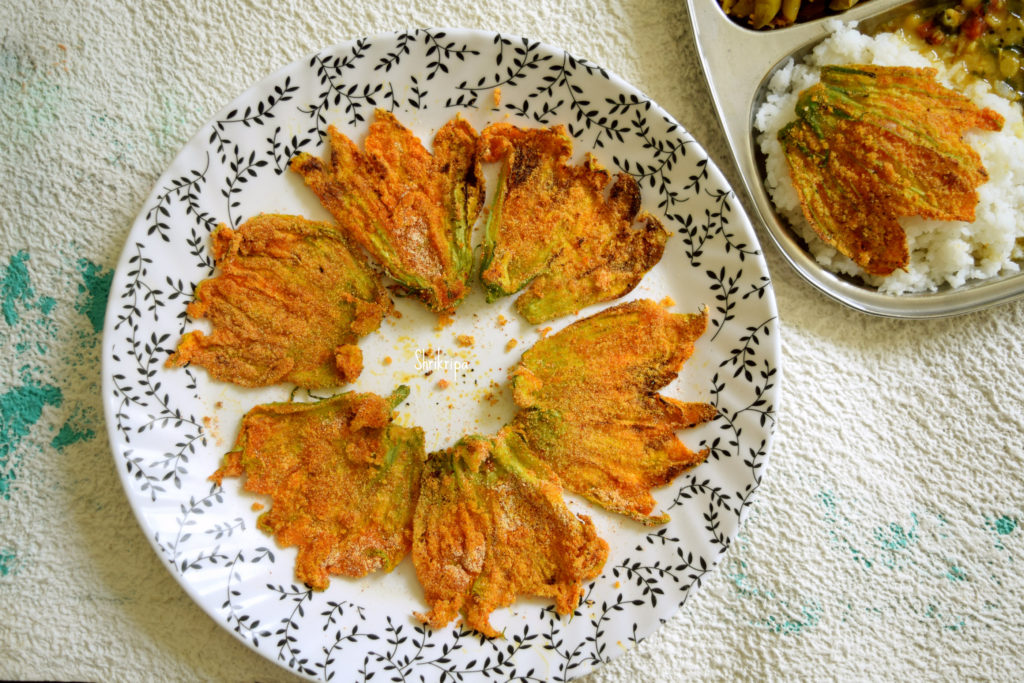
DSC_4222_Fotor main

This is how I make-

Ingredients:

Pumpkin flowers – 5 to 6

Fine semolina – 1 small cup (chiroti rawa)

Salt

Hing – ¼ tea spoon

Turmeric powder – ½ tea spoon

Red chilli powder – 1 tea spoon

Coconut oil – as needed

Method:

-Wash flower, give one fine slit at the bottom of the flower and cut open.

-Remove stamen.

Ribbet collage 1

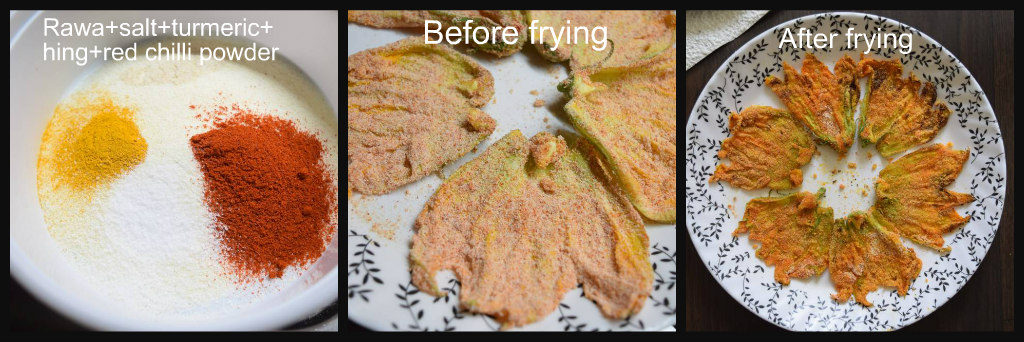
-Dry mix all seasoning items from rawa, salt, red chilli powder, turmeric powder and hing.

-Take each flower and coat with the seasoning, by rolling.

-Heat iron tawa/ griddle, place all these coated flowers.
Ribbet collage 2

-Roast these by using sufficient coconut oil on both the sides.

-Serve these with hot rice and Rasam or dhal.


Balloon Vine Dosa:

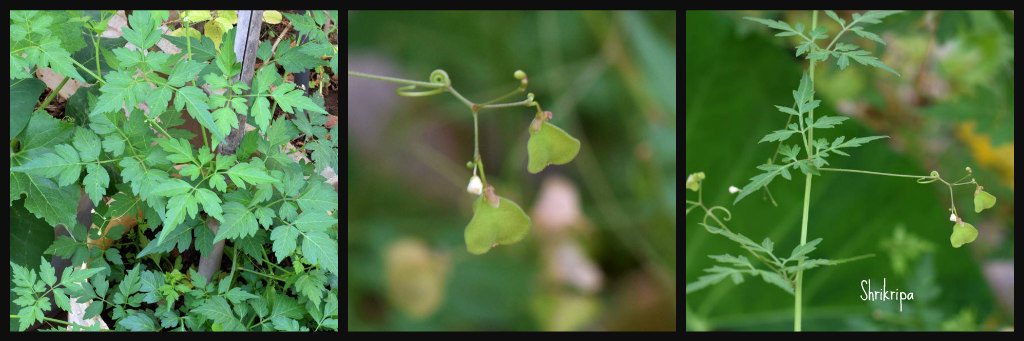
Balloon vine is well known and widely used as medicinal herb. In Tamilnadu it is used mainly in treating joint pains. I was not aware of this super food until recently which was introduced to me by our beloved uncle Senguttuvan on our Facebook Foodie group. I am very lucky to experience the taste, because of my Foodie friend Ashwini, who came all the way to my home and dropped off the leaves and asked me to prepare the Dosa. 😊

It is a medicinal herb and botanical name is cardiospermum halicacabum (Family sapindaceae).

Balloon vine is also known as Heart seed, Heart-Pea, Love in a puff, winter cherry (English).

The plant got its name because of its Balloon like seed pods.

Some of the regional names are-

Indravalli – In Sanskrit

Agniballi, bekkinatoddinaballi, erumballi – In Kannada

 Mudakathan keerai – In Tamil

Jyotishmati, katabhi – In Malayalam

Kapalphoti, khanphuti – In Hindi

It has numerous health benefits and is used in many ailments from Anaemia, diarrhoea, eczema, rheumatism in the form of tea, paste application, kozhambu or mixed with Dosa batter etc.

I tried this Dosa by grinding fresh batter by mixing the leaves in, and it was very tasty. It tastes like plain Dosa with green natural colour.

DSC_4279_Fotor

Now we will see the procedure-

Ingredients:

Dosa rice – 1 cup

Idly rice – 1 cup

Urad dal –¼ cup

Chana dal – one fist full.

Methi – 1 teaspoon.

Balloon vine greens – 2 cups

Cumin – 1 teaspoon

Red chilli – 1 (use Byadagi variety)

Salt

Method:

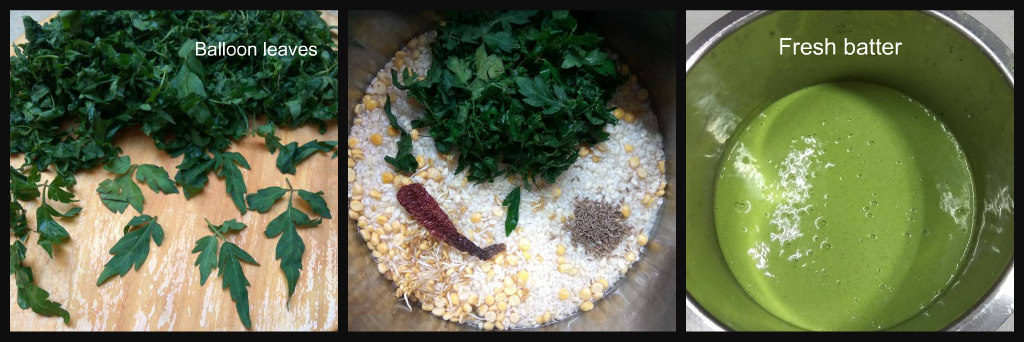
-Wash and soak Dosa rice, idli rice, methi and soak for 3 hours.

-Wash cleaned greens and keep them aside.

Ribbet collage 1

-Grind soaked rice, greens, salt, cumin, and red chilli into a fine paste.

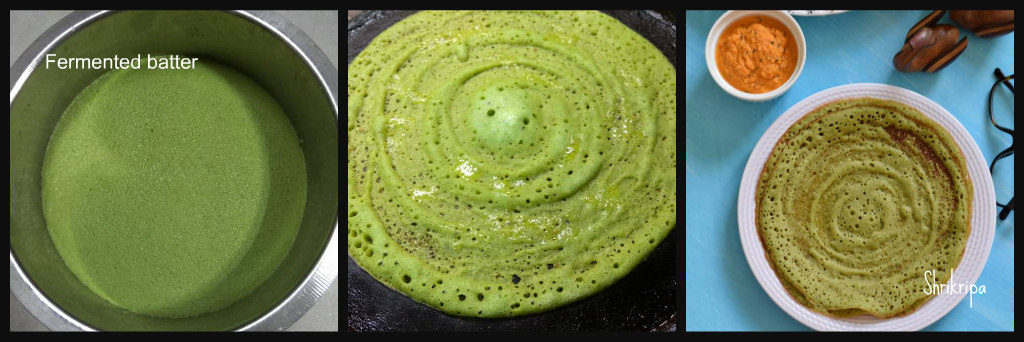
-Ferment the batter for 8 to 10 hours or overnight.

-Next day mix the batter, and adjust the consistency.

Ribbet collage 2

-Heat Iron Dosa griddle, pour one serving spoon of batter, spread and cook on one side.

-Pour some ghee or oil and flip the side and cook.

-Serve the Dosa with any chutney of your choice.

Gujje palya/ Tender jackfruit Subzi:

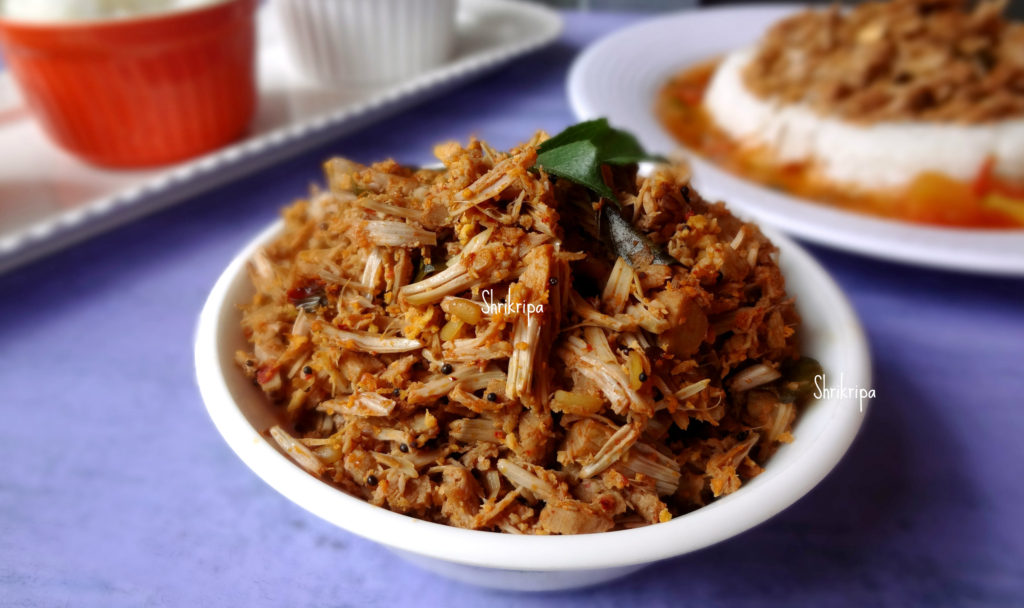
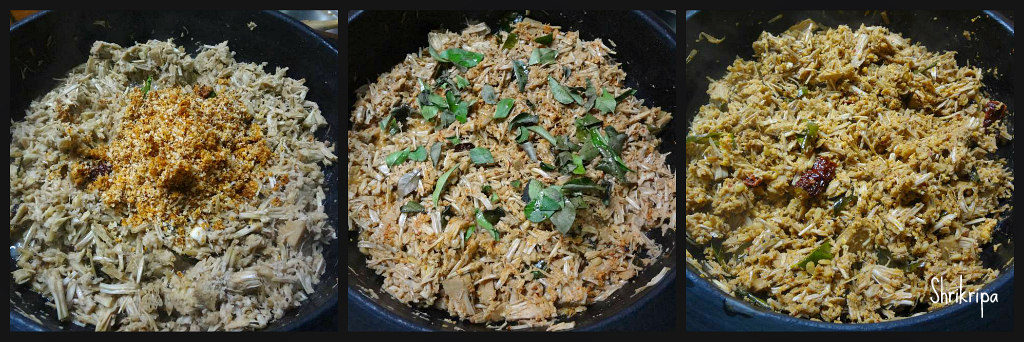
Gujje is nothing but tender jackfruit. We Mangalore people start using Gujje from its very tender form. This particular recipe is for very tender means even before its formation of eyes (seed) and known as “Guddhi palya” as it is prepared after crushing. We will see how to prepare this in a traditional way.        

DSC06083_Fotor

Ingredient:

Tender jackfruit – 1

Mustard- 1 tsp.

Black gram dal – 1 tsp.

Red chilli – 1 (for seasoning)

Curry leaves – 4 springs

Coconut oil – 4 tsp.

Red chilli powder – 1 tsp.

Turmeric – ½ tsp.

Tamarind – ½ tsp.

Salt and jaggery – for taste.

Grated coconut – 3 tbl sp.

Methi seeds – ½ tsp(roasted)

Red chilli – 2 to 3 (roasted)

Method:

  • Remove outer thorny skin and centre core. Cut the inner pith into one-inch cubes. Immerse in water for 10 minutes. Drain and keep aside.
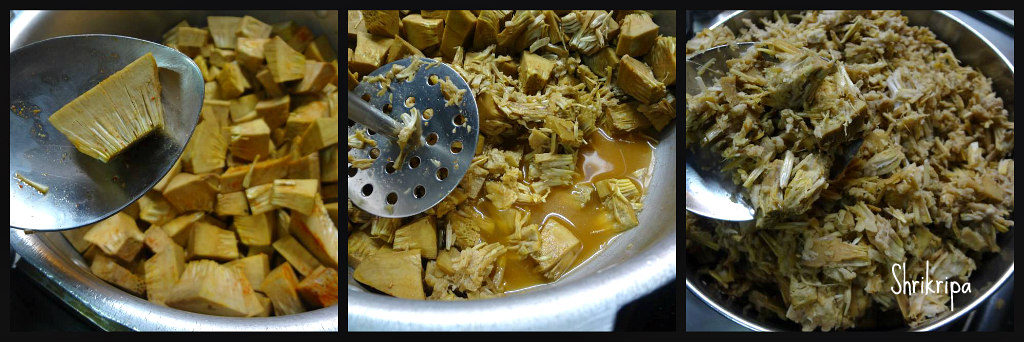
  • Take one thick-bottomed kadai or pressure cooker. I usually prefer one whistle a pressure cooker. This method fastens the procedure.
  • Put chopped jack pieces, salt, tamarind, jaggery, red chilli powder, turmeric. Now add a cup of water and cook until one whistle.

Ribbet collage 1

  • When it becomes cool, remove the cooker lid.
  • Mash the cooked jack a little so that all the segments of the jack pieces will open, and it will help to enhance the taste and structure of the palya.
  • Dry grind coconut, roasted methi and red chilli into rough powder and add.

Ribbet collage 2

  • Now check for the seasoning and cook until any remaining water is dried and the masala cooks and coats well.
  • Garnish with curry leaves, two tsp. Take raw coconut oil, keep it closed, and cook for a while so the coconut and curry leaves’ flavours will spread to give a very authentic “homely” flavour.
  • Season it by heating coconut oil and adding mustard. When it splits, add Urad dal, red chilli and curry leaves and pour over the ready palya/sabzi.
  • This palya will taste great with ghee and hot rice or as a side dish with Rasam rice.


Baby potato fry:

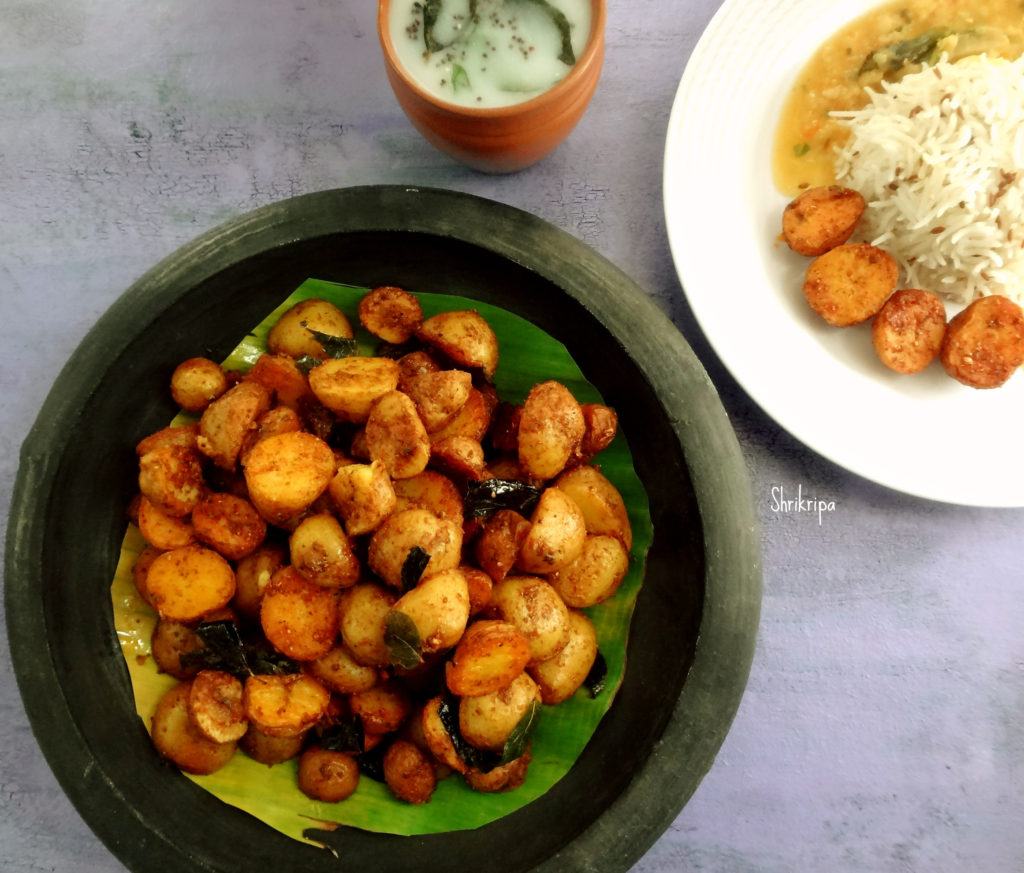
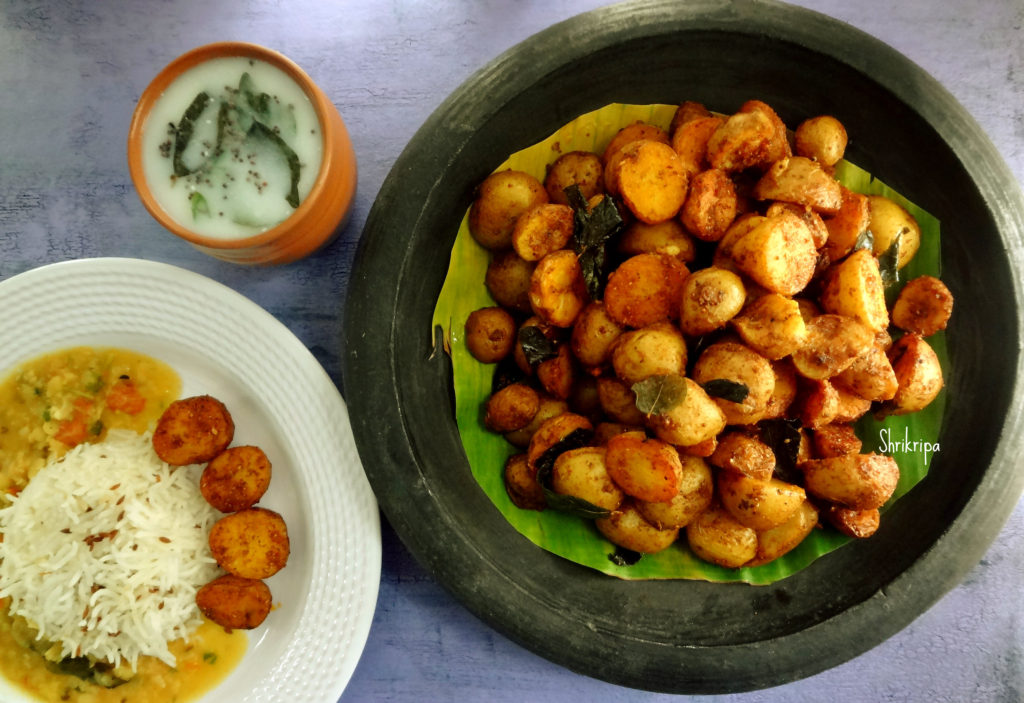
Baby potatoes are naturally sweetish with thin outer skin. I usually don’t peel baby potato skin, due to its richness in taste as well as vitamins and minerals as well. This potato fry tastes great as it is or as a side dish with plain dal or Rasam.

I am preparing this potato fry from so many years and my guests usually love this and ask for the recipe, so I thought of sharing the recipe with my readers, as well. It is made with very minimal oil and one can indulge in it, as much as they want.

DSC03768_Fotor

How I make:

Ingredients:

Baby potatoes – ½ kgs

Salt- as needed

Oil – 2 table spoons

Curry leaves – 2 springs

Turmeric – ½ tea spoon

Red chilli powder – 1 tea spoon

Coriander powder – 1 tea spoon

Garam masala powder – ½ tea spoon

Amchur/ dry mango powder – ½ tea spoon

Method:

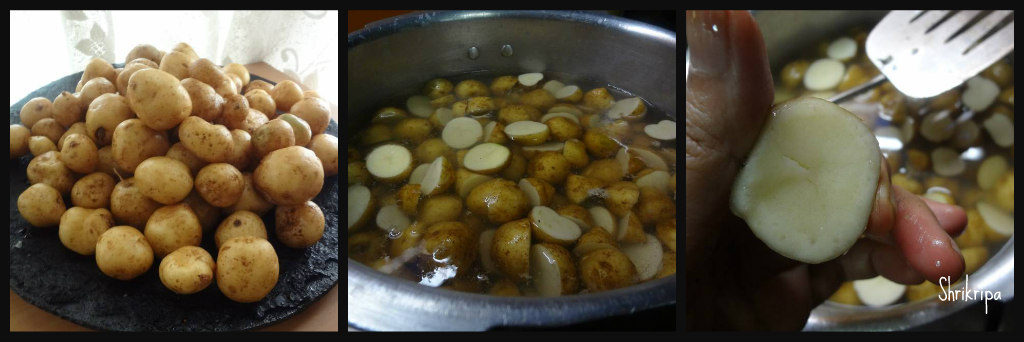
-Soak baby potatoes for some time, scrub a little and clean properly.

-Cut all the potatoes in half.

-Take water in a sauce pan, boil, add halved potatoes in this water and cook until it is tender but firm.

Ribbet collage 1

-When you keep the potatoes in between your thumb and fore finger and press, it should crack.

-Switch off the gas, drain the water.

-Now take one tawa, heat oil, splutter curry leaves, add drained potato pieces and fry for 2 to 3 minutes.

Ribbet collage 2

-Add all the powders, salt and fry until you get a little charred texture.

-Check the taste and adjust the masala accordingly.

-Serve either as a starter or side dish with rice and dhal.

DSC03780_Fotor

NOTE: If you have Ready Tawa fry masala (MDH brand) use 3 to 4 tsp of that, omit coriander powder, garam masala, red chilli powder and amchur powder.


Protein rich Millet Health Mix:

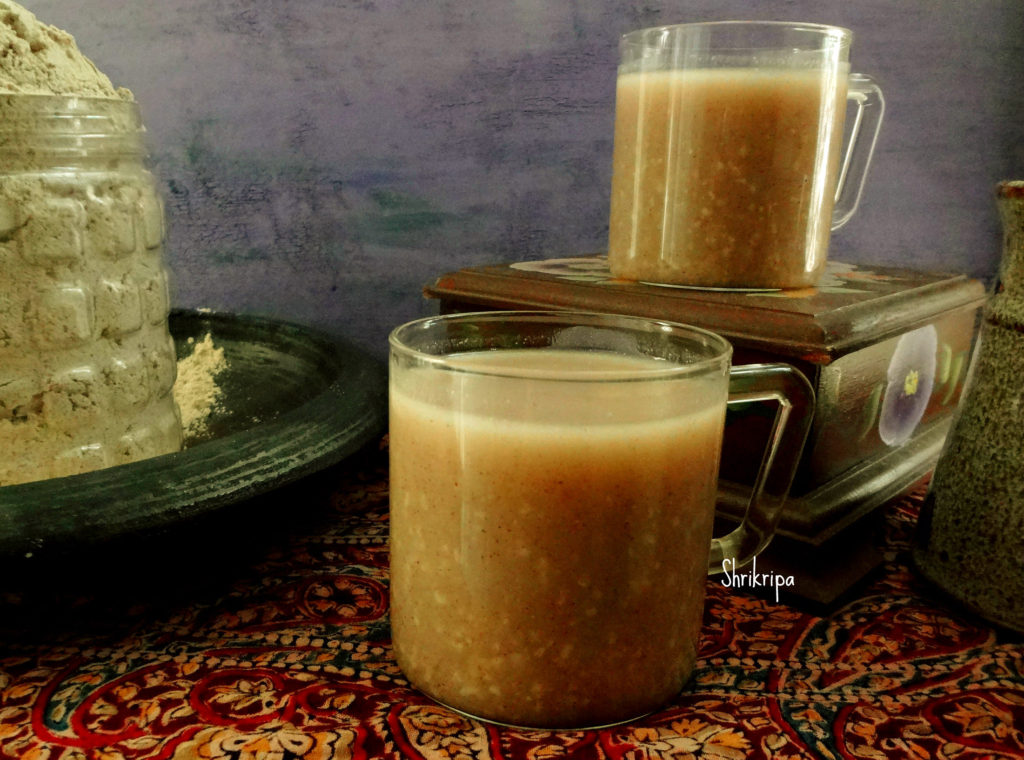
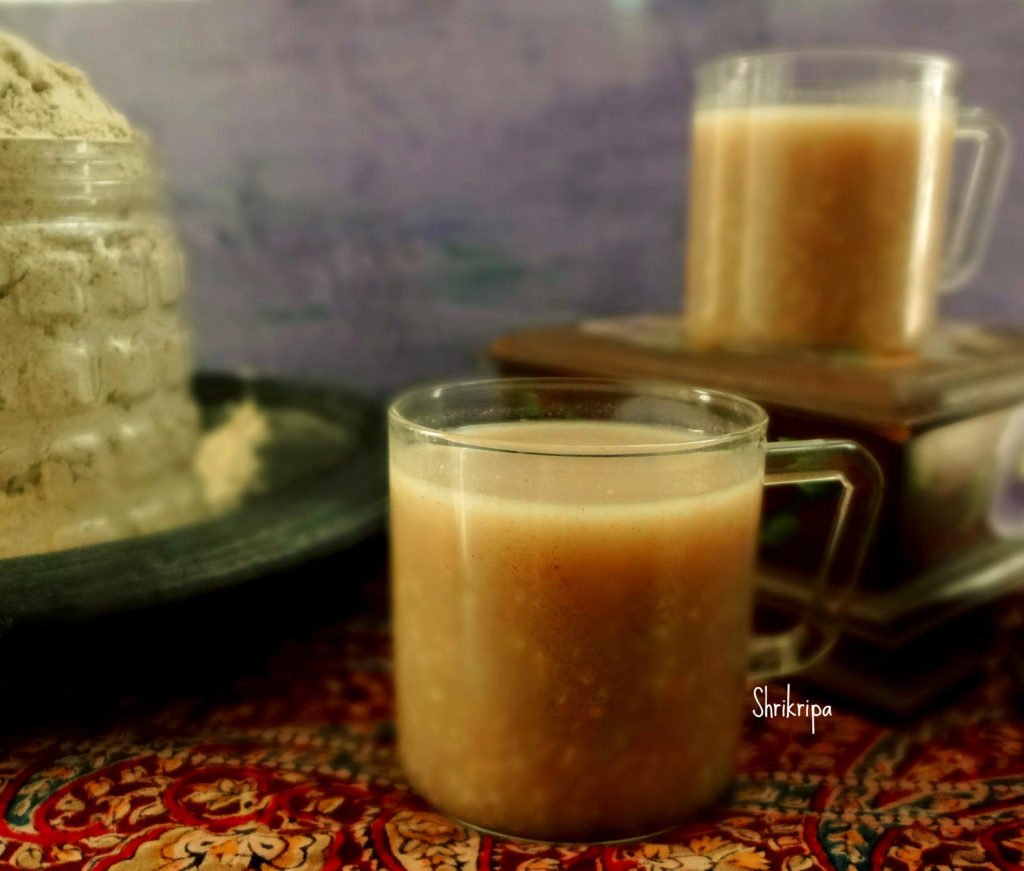
Millet health mix is a wholesome breakfast solution for people who leave their home very early in the morning and yet they can get goodness of wholefood by preparing quick porridge. Once the powder is ready, it is super easy and quick to prepare and consume. One can even prepare this drink and carry it in their bag and have it at their convenience as well.

Health benefits of millets and sprouts are numerous. They are filled with nutrients, vitamins and minerals. It really boosts immune system and overall health of human body.

I prepare this porridge specially for my husband, who started following Naturopathic diet after staying and enjoying this simple diet in a Naturopathic centre. Gradually my niece who leaves home by 6:45 AM from home, started carrying this drink as her mid-morning “meal”. It is very tasty, and at the same time, healthy, filling and nutritious too.

DSC03935_Fotor

At first, we will prepare the powder and the procedure goes like this-

Ingredients to sprouts and Roast:

Whole wheat – 500 grams

Finger millet / Ragi – 500 grams

Pearl millet/ Bajra – 100 to 150 grams

Green gram / whole moong – 250 grams

Black Chana – 250 grams

Ingredients Only to roast:

Fox tail millet – 50 grams

Sorghum / Jowar – 50 grams

Organic Red rice – 50 – 100 grams

Sago – 100 grams

Roasted Chana – 50 to 100 grams

Almonds – 100 grams

Flax seed – 25 grams

Other ingredients:

Cardamom – 10 (whole)

Method:

-First wash all the ingredients under “Ingredients to sprouts” one by one.

Ribbet collage 1

-Soak all these for 6 to 8 hours or Overnight.

-Drain and keep it covered to germinate.

-Next day morning, spread these on a clean cloth separately, and dry under partial or direct sunlight.

-It takes 2 to 3 days to perfectly dry.

-Now you can start roasting all these dried items one by one, as well as ingredients under “Only to roast”.

-After roasting each ingredient, spread this on a newspaper or clean cloth and cool.

-Add cardamom.

– Powder this mixture in a flour mill.

Ribbet collage 2

-Store this ready flour in an air tight container and use as needed.

How to make the porridge:

I make it in two ways. One is plain and another one is with oats.

For the plain one:

Ribbet collage 3

Take 4 spoons of porridge powder, add 450 ml of water, or as much as you want, according to the required consistency, and boil until it is cooked properly.

At that time, mixture will become glossy.

My husband likes this porridge with a little rock salt and a tinge of sweet (usually I add sugar free Natura)

You can either add plain sugar or Jaggery or brown unrefined sugar as well.

With Oats:

DSC03932_Fotor

Take 2 spoons of porridge powder, 2 spoons of Oats and proceed with the above procedure.

Steamed rice with Hot and sour vegetables:

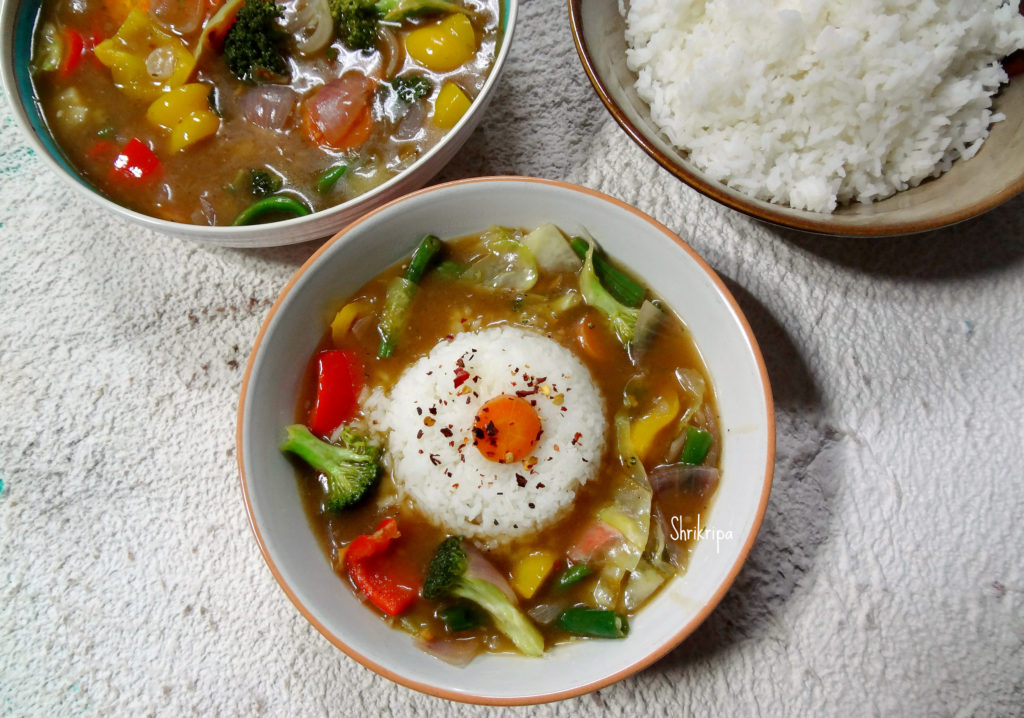
Hot and sour veggies with some steamed rice works perfect for a winter night dinner. It is light, filling at the same time, very nutritious and tasty as well. It doesn’t need any major preparation and I love making it on winter nights when we need a tongue tickling hearty dinner.

It is very simple, usually I use some chunks of veggies which is tossed with chunks of onion and simmered with one packet of hot and sour soup powder with sufficient water. Yes!! It is such a simple affair. While serving I usually take a couple of spoons of cooked rice as well.

This quantity suffices for a 4-member family.

DSC05442_Fotor

How I make –

Ingredients:

Onion – 1 big

Green chilli – 1

Veggies – 1 bowl (veggie pieces in byte sizes)

Garlic salt or chopped fresh garlic – little

Oil – 1 table spoon

Hot and Sour Veg soup – 1 pack (Knorr Or Maggi brand)

Basil or Lemon grass – for an additional flavour (optional)

Method:

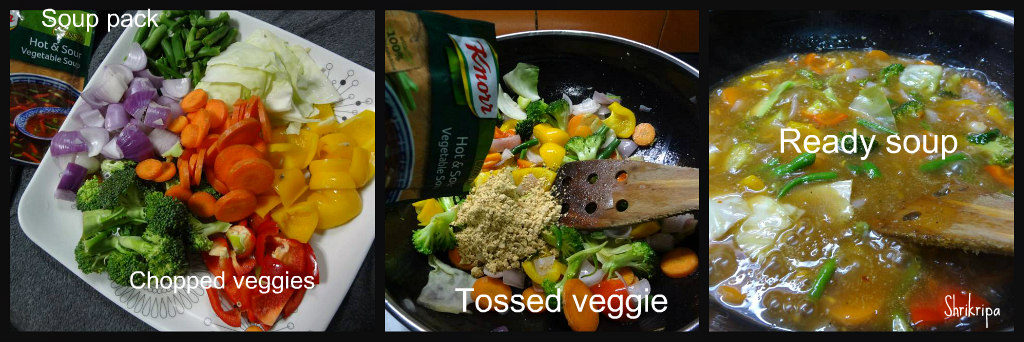
-Chop vegetables and onions into chunk size. Slit green chilli. If you are using garlic, chop that as well.

Ribbet collage 1

-I usually prefer French beans, carrot, broccoli or cauliflower, capsicum, cabbage or lettuce.

-Take one big wok, pour oil, when it is hot, if you are using garlic, add garlic, green chilli, onion and fry for a minute.

-If you want to use basil or lemon grass, add now.

-Add vegetable chunks and toss. If you are using garlic salt, add it now, otherwise you can also add plain salt.

-When veggies wilts, add one pack of soup powder and mix.

-Add 4 cups or more of water to adjust the consistency.

-Boil until gravy cooks up and becomes shiny.

DSC05438_Fotor

-Serve with plain steamed or cooked rice.


Cucumber Chutney:

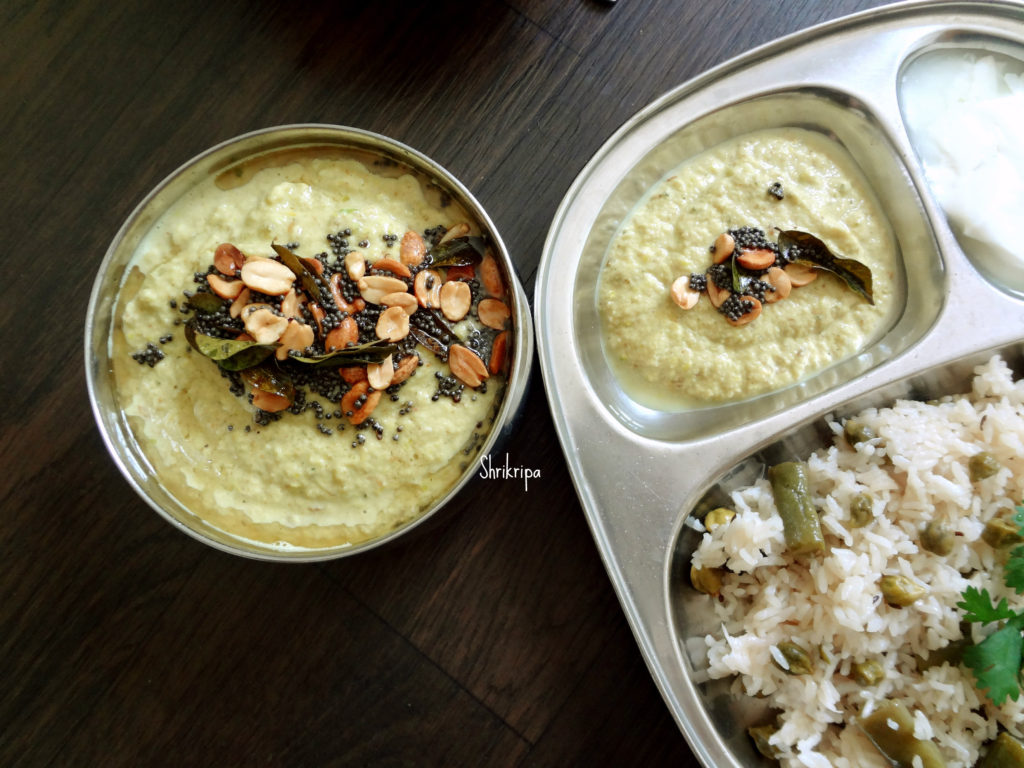
When I saw this chutney recipe in our Facebook Foodie group, I was attracted mainly because of the veggie. One of my daughters loves cucumber and I tried this recipe by pairing it with very mild flavoured Fresh chick peas Pulav. It was a pair made in heaven, and everyone liked this chutney, not only with the Pulav, but also with rice, Dosa or chapati. 

This recipe is by Jayanth Desai one of our Foodie member and all thanks to him for sharing this flavourful chutney of North Karnataka region.

DSC05898_Fotor

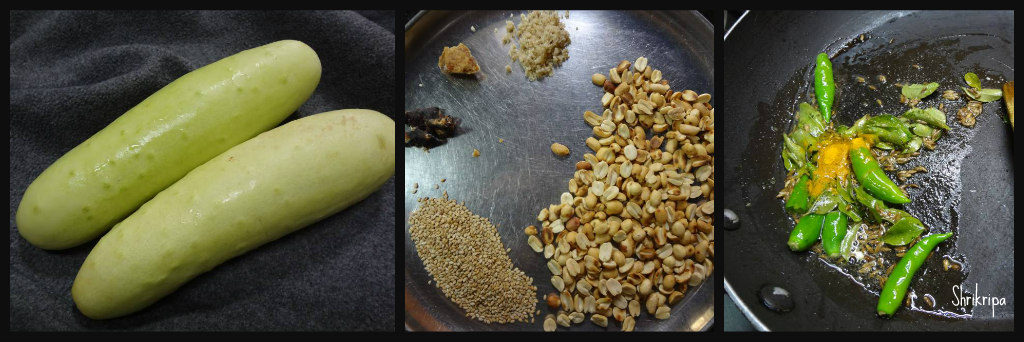
Ingredients:

Cucumber – 2 (grated)

Green chillies – 3 to 4

Curry leaves – 2 strings

Turmeric – ½ tea spoon

Oil – 1 table spoon

Hing – ¼ tea spoon

Cumin – 1 tea spoon

Peanuts – 5 tea spoons

Sesame seeds – 2 tea spoons

Tamarind – gooseberry size

Jaggery – small piece

Salt

Seasoning:

Oil – 1 tea spoon

Mustard – ½ tea spoon

Peanut – 1 tea spoon

Method:

-Dry roast sesame seeds until it splutters.

-Dry roast peanuts. Keep aside.

Ribbet collage 1

-In the same pan, heat oil, add hing, cumin, curry leaves, green chillies and fry for a minute.

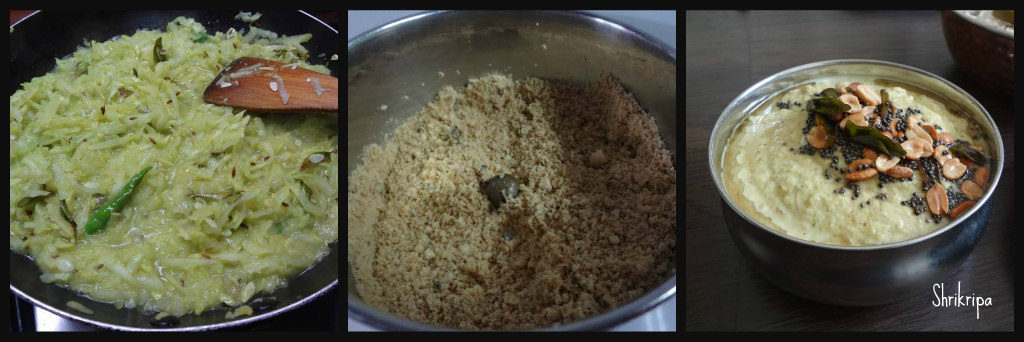
-Add grated cucumber, turmeric and fry until cucumber changes in colour and cooks.

Ribbet collage 2

-Cool the mixture.

– Take one mixer jar, add roasted sesame, peanuts and make powder.

-To this, add cooled cucumber mixture, jaggery, tamarind and salt.

– If necessary, add very little water and blend into smooth paste.

-Do seasoning by heating little oil, mustard and peanuts.

-Serve as you wish.


Winter Veggie Pickle/Gajar, Gobhi aur shalgam ka achar:

Winter vegetables are very juicy, which can be preserved and enjoyed during the off season as well. In Northern India mainly in Punjab, they preserve these veggies by making pickle. I am very much fond of all kinds of pickles right from our traditional non-oily baby mango pickle to Andhra Avakaya and Punjabi mustard oil soaked root vegetables. No meal is complete without pickle. I usually prefer homemade pickles over store bought one and usually stocks lots of varieties for our regular usage. People who know me will surely agree with this. 😀

DSC05599_Fotor

In this Pickle we use seasonal Red carrots, radish, cauliflower and Turnip chunks. Which is mixed with assorted spices, salt, jaggery and mustard oil. It is a classic combination with any kind of Indian flat breads.

How I make-

Ingredients:

Carrot – 250 grams (Red or Baby carrots)

Radish – 250 grams

Turnip – 250 grams

Cauliflower – 250 grams

Salt – ½ cup+ 1 table spoon (as needed)

Mustard oil – 50 ml

Refined cooking oil – 50 ml

Garlic cloves – 10

Yellow mustard – 50 grams

Turmeric – 1 + 1 tea spoon

Kashmiri chilli powder – 20 grams

Normal chilli powder – 20 grams

Vinegar – 50 ml

Jaggery – 75 grams

Method:

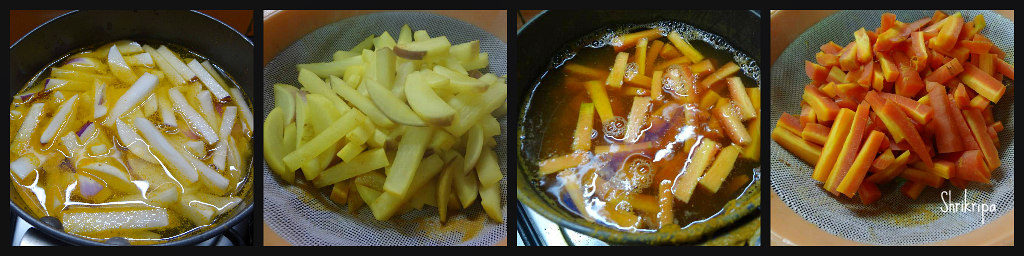
  • Wash, cut carrots, Radish, Turnip into long pieces.

DSC05546_Fotor

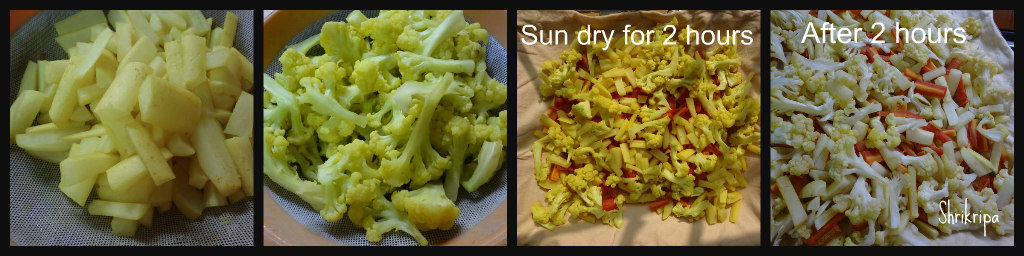
  • Remove small florets from cauliflower. Wash and drain.
  • Boil 4 to 6 cups of water in a big vessel. Add 1 table spoon of salt and 1 tea spoon of turmeric.

Ribbet collage 1

  • Blanch cauliflower, radish, Turnip, carrot pieces separately and drain and cool.
  • Spread these on a clean towel and keep it under the sun for 1 to 2 hours to remove all the water content.

Ribbet collage 2

  • If you are keeping and drying it inside the house, please switch on the fan or keep it for long hours, until it is dry.
  • Now keep everything ready for pickle masala and seasoning.
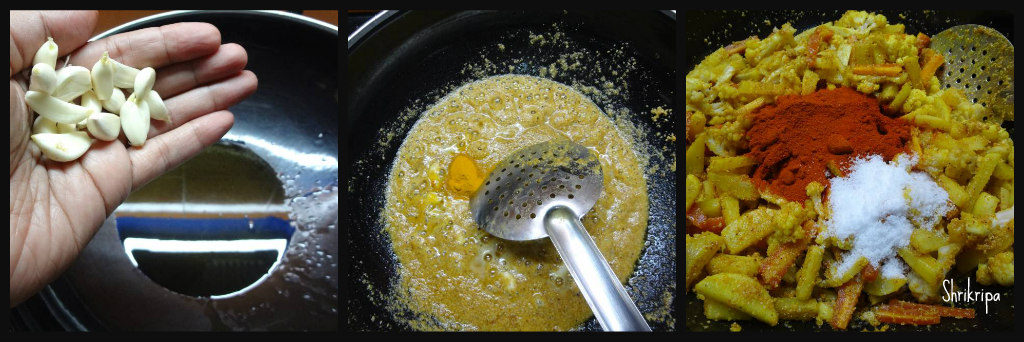
  • Take one thick kadai, pour oil, when it is hot, add garlic and fry for 2 to 3 minutes.

Ribbet collage 3

  • Add crushed yellow mustard, fry for one to two minutes.
  • Immediately add turmeric and dry veggies. Mix nicely.
  • Add both the chilli powders, salt and mix nicely.
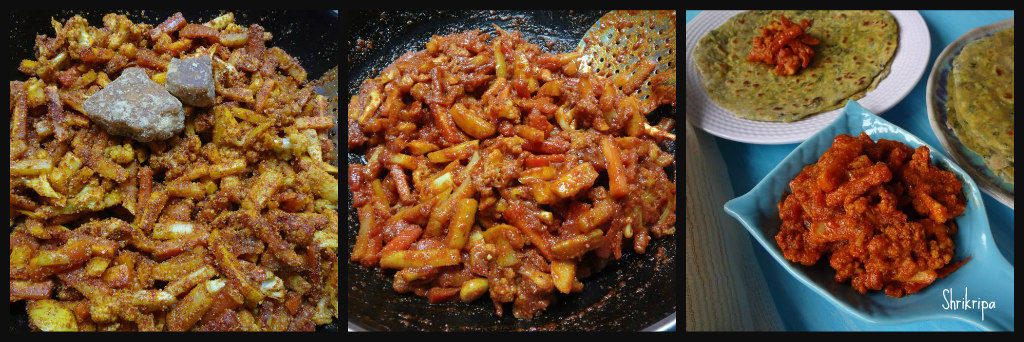
  • Then add grated jaggery (I have kept the jaggery piece to show) and vinegar.

Ribbet collage 4

  • Cook until all the masalas and liquid absorb and becomes like a mass.
  • Cool the mixture, store this in a clean, dry glass bottle.
  • It will set in a weeks’ time and one can relish after that period.
  • After it sets, I usually prefer storing it in the fridge to prolong its shelf life.

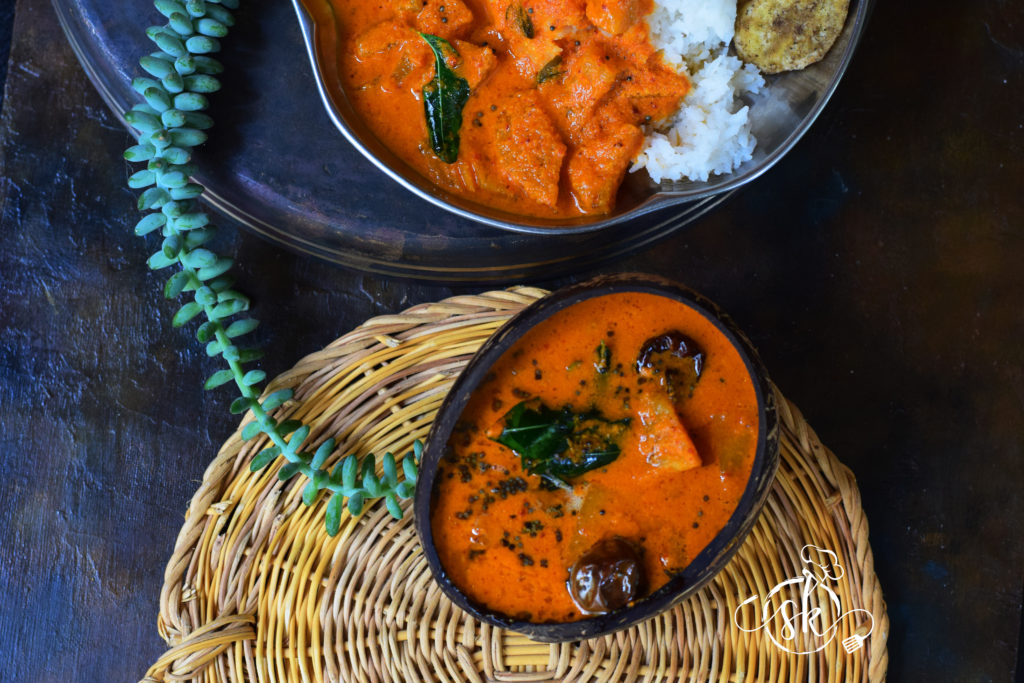
Pineapple Menaskai/ Gojju:

Menaskai/Menaskayi is one of our coastal specialities, which is a hot, sweet and sour, sesame flavoured coconut-based curry. Normally made with bitter or tangy things like Bitter gourd, raw mango, wild mango or pineapple. We even prepare by mixing Bitter gourd and raw mango as well. It is a common dish in any of our elaborate menus for festivities, usually served on a plantain leaf, like poojas or weddings. This same curry is prepared in a little different way in other parts of Karnataka and known as “Gojju”.

Here, the main trick is-balancing of all the flavours.

If you are preparing with sour vegetable or fruit, there is no need to add additional tamarind. For example, if you are preparing raw mango or mixture of bitter gourd and raw mango Menaskai, there is no need to add tamarind. If you are using pineapple, tamarind should be added.

Here I have used pineapple and the procedure goes like this-

Ingredients:

Pineapple – 1/2 (chopped into bits)

Raw mango – 1/4 (chopped into bits)

Tamarind – gooseberry size (if the mango is not available)

Jaggery – as needed

Salt

Green chillies – 2 (slit)

For masala:

Fresh Coconut gratings – 1 to 1 ½ cups

Methi seeds – 1/4 tsp

Urad dal – 2 teaspoons

Sesame seeds – 2 teaspoons (U can use black or white)

Dried red chillies – 8 – 10 (we use Byadagi variety)

Coconut oil – 2 to 3 teaspoons (1 for roasting + 1 for seasoning + 1 tsp to garnish)

Mustard – 1 tsp

Dried red chilli -1

Curry leaves – 2 springs

Method:

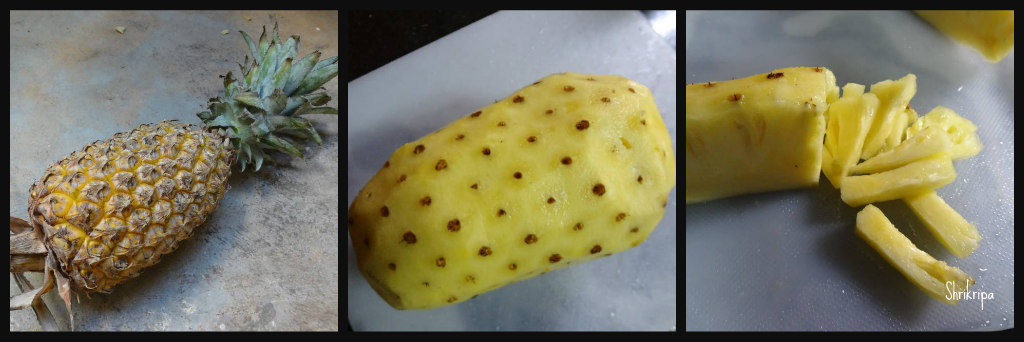
-Clean pineapple by removing the outer skin, chop into bite-size pieces.

Ribbet collage 1

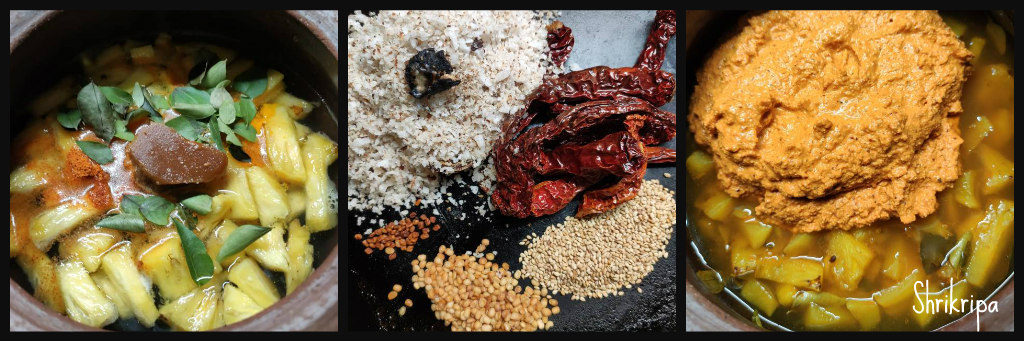
-Cook pineapple pieces and mango pieces or tamarind with little water, turmeric, salt, jaggery, green chillies and curry leaves.

-Dry roast sesame seeds. Now fry all the masalas for grinding. First heat 1 tsp of oil, put methi(fenugreek) seeds. When it is light brown, add all the other ingredients like urad dal,  red chillies and fry until urad dal is light brown. Now it is the time to put coconut and fry further for 2 minutes or until you smell the nice aroma.

-Cool the mixture, grind into a paste by adding sesame seeds and sufficient water as well.

-Add this paste to the cooked pineapple, check for salt and jaggery. Adjust the consistency by adding water and boil nicely in a simmer for 5 to 10 minutes.

-After boiling, add 1 tsp of raw coconut oil as well as the seasoning with coconut oil, mustard, red chilli and curry leaves. Close the lid and leave it to soak all the masalas for half an hour.

-Serve with hot rice.

Note:

-After boiling, the gravy should be a little thicker than normal sambar.

-Taste should be sweet, sour, hot. So adjust the addition of jaggery accordingly.

– We usually relish this dish the next day of preparation, usually with Neer Dosa or chapati/Roti. 😊


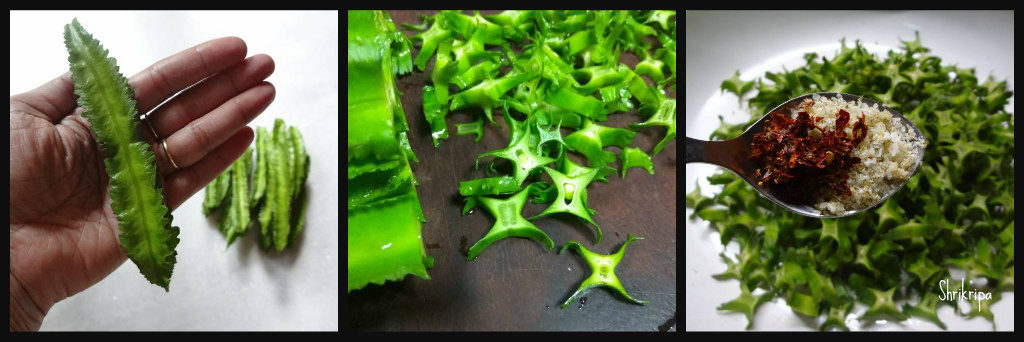
Soppavare/Winged beans stir-fry:

Soppavare name itself is very much nostalgic. We had a widespread vine in our front yard and we used to relish a whole lot of Mangalorean traditional recipes in our childhood days.

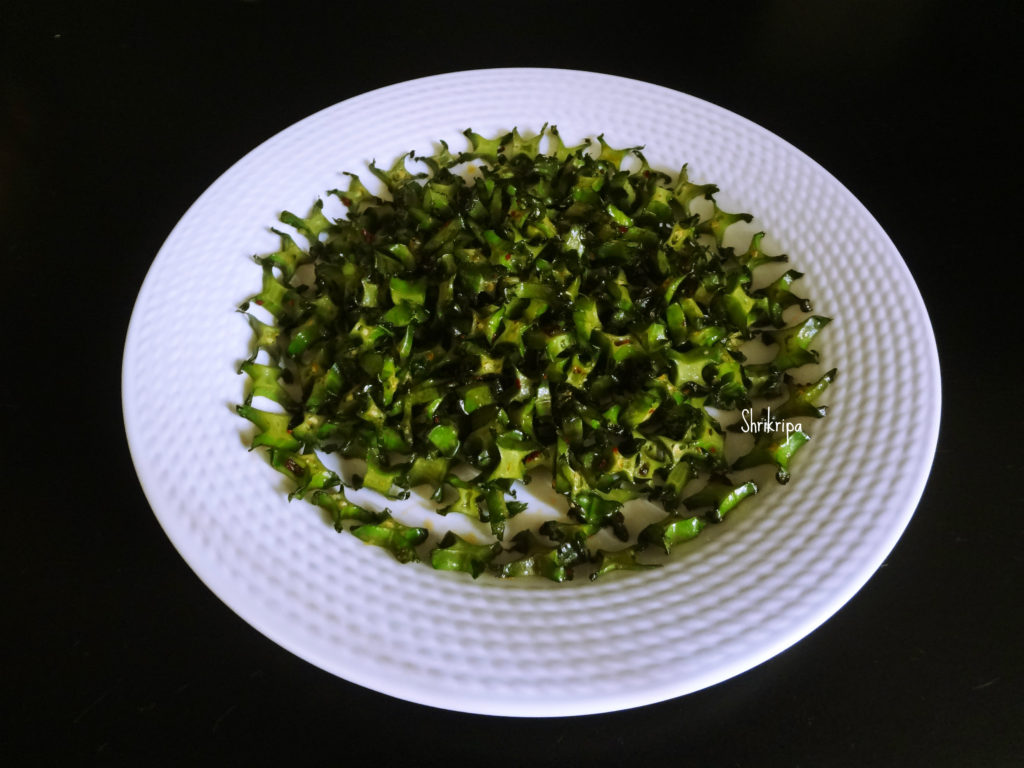
Winged bean is a nutritionally very rich, tropical vine, which needs warm weather, but in the winter season. Almost all parts of the plant are edible, and vine produces unique shaped bean with four-winged edges.

It is rich in vitamins, minerals and many nutrients. When it is cooked, bean has nutty flavour and is consumed in many forms from salad to stir fries or in a form of curry.

My family relishes on this simple stir-fried salad with this simple seasoning.

DSC05152_Fotor 1

Ingredients:

Winged beans – 10 -15

Olive oil – 2 tsp

Garlic salt – 1 tsp

Chilli flakes – ½ – 1 tsp

Method:

Ribbet collage 1

  • Wash and slice the beans.
  • Heat one non-stick tawa add olive oil, add chopped beans, garlic salt and red chilli flakes.
  • Stir fry for a while and serve as it is or with curd rice or as you wish.