Thagathe Soppina Vada/Cassia Tora Fritters:

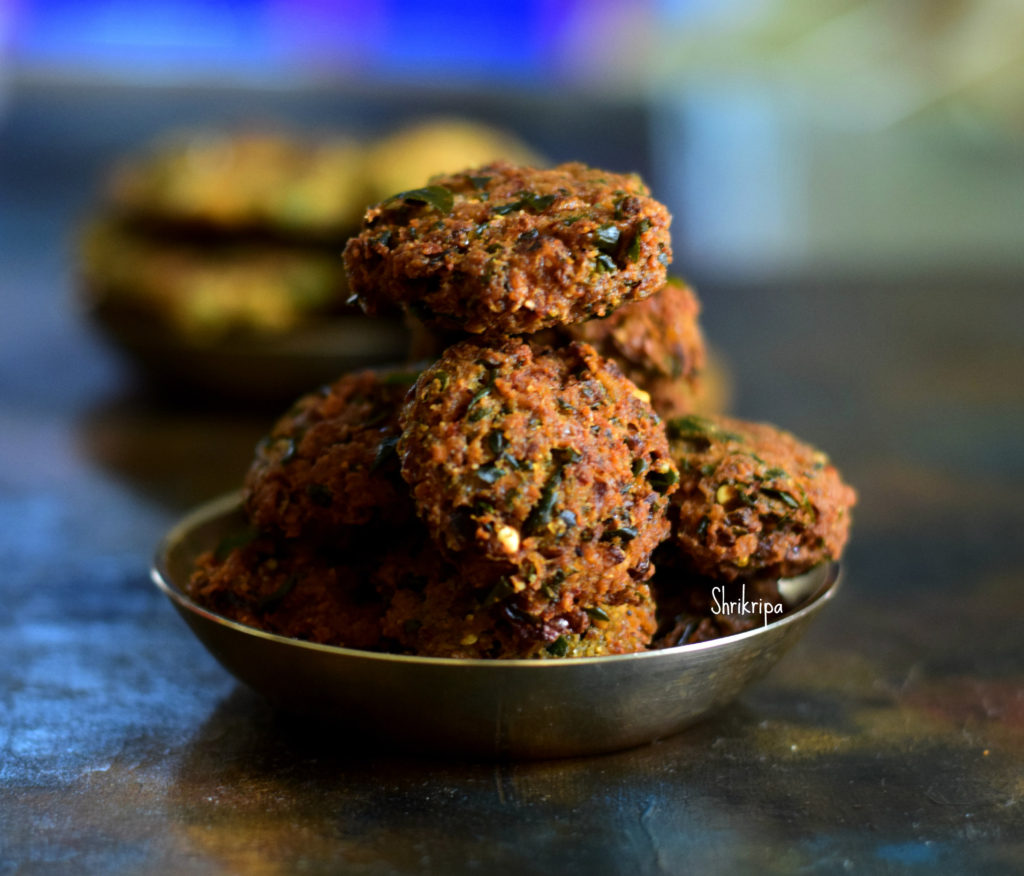
Thagathe soppu is nothing but Cassia Tora or Senna Tora in English. It mainly grows as a weed in open grounds or road side in Rainy season. It is a very useful plant and mostly ignored by all. Leaves of this plant are not only used as a medicine; its seeds are also used widely in Ayurveda.

In our coastal belt, we do prepare lots of delicacies from its young leaves and this vade or fritters is one among them. These fritters are served as a snack or as a starter for lunch/dinner. This monsoon delicacy is also called dangar in Konkani. 
Ingredients:

Dosa rice – ¾ cup

Toor dal – 2 tablespoons

Dried red chillies – 5 – 8 ( Byadagi)

Salt

Hing – generous pinch

Tamarind – ½ tsp

Coconut – ½ cup

Chopped greens – 1 to 2 cups ( as needed)

Chopped onion – 1

Method:

– Wash and Soak rice and dal for 3 hours.
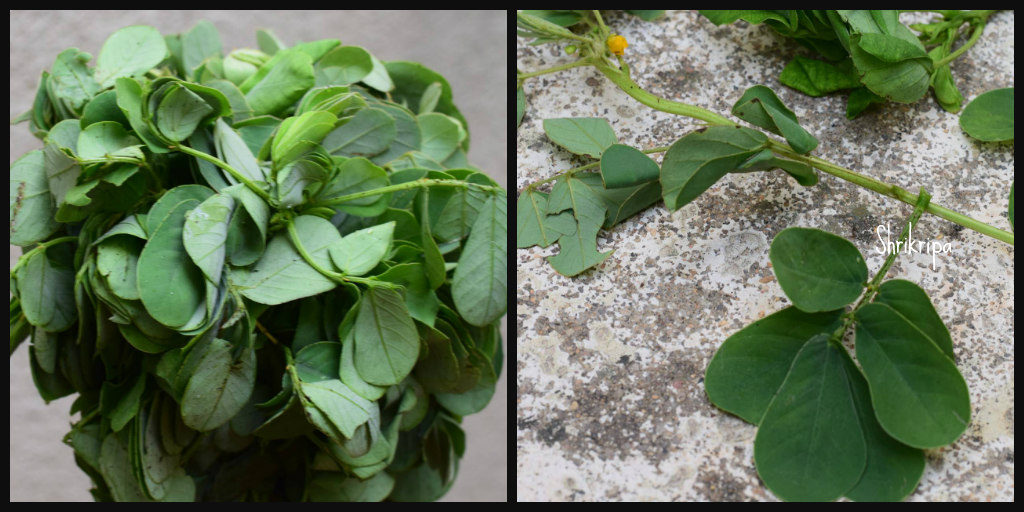
-Roast red chillies, chop onions , Clean the leaves, remove stalks, wash thoroughly ,chop the leaves and keep it ready.

– At first grind coconut, hing, salt, red chillies in to paste.

– To this, add soaked rice and dal mix, grind this into a small rava consistency by adding very little water.

– Remove from the mixer grinder, add chopped leaves , onion and mix thoroughly. 

-Heat oil in a small kadai. When it is hot, take bite size of batter and pat a little in your palm and deep fry.
-Serve this as a side dish with Dal – Rice or Rasam and rice.
 

Note: If you don’t have access to Cassia Tora leaves, instead you can use chopped Moringa or Methi or fenugreek leaves as well.
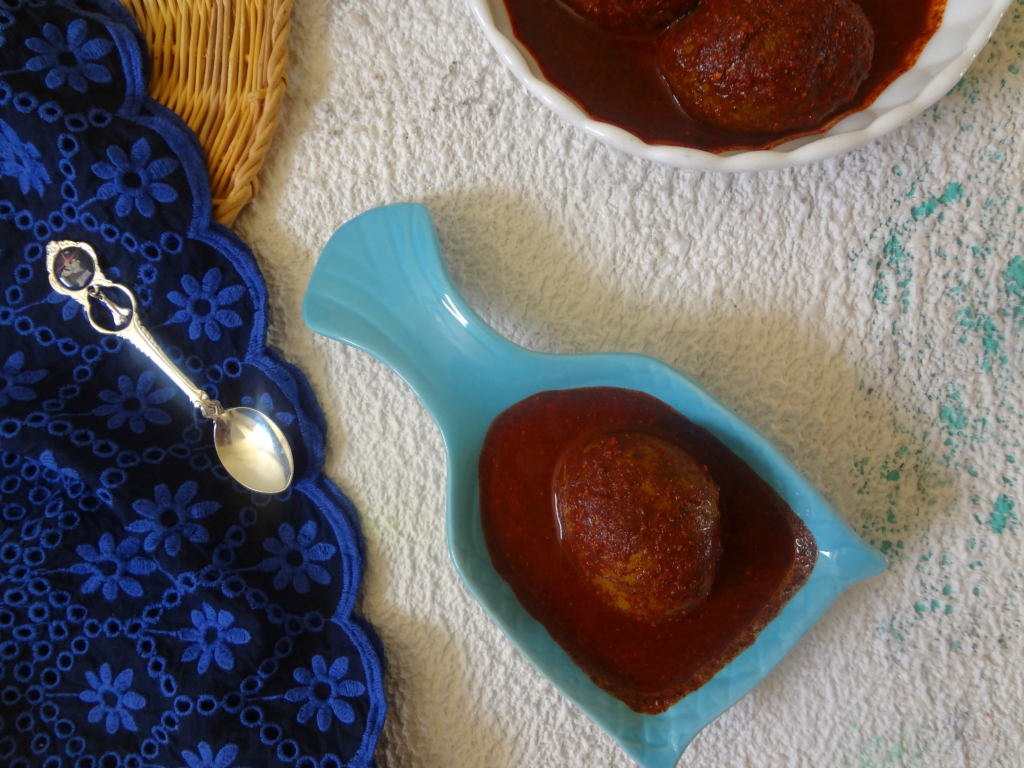
 

Idikayi Uppinakai / Whole mango pickle in roasted masala:

Happiness is when your reader as well as a distant cousin of yours messages you and requests you to post one of our traditional age-old pickle recipe. When you respond saying, this variety of mango (wild raw mango) is not available where you reside. Immediately comes the response, he will bring and give it to you. Not only bringing this raw mango from 250 km away, he has not forgot to remind me, “Don’t forget to post”. This post is dedicated to him, Rajendra. G.

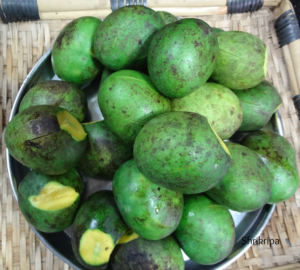
Idikayi is nothing but whole mango. We use wild whole mango in this pickle. Speciality of this pickle is, it is fully grown, just before ripening stage of mango. So, while eating, you can enjoy and savour salted seed as well. Usually we relish this with Kerala matta rice kanji or normally we call as, kucchilakki ganji with this pickle.

Masala is used in this pickle is roasted and fried with very little oil. So literally it is very mildly hot pickle without oil. Even small kids relish this.

pic 2

Ingredients:

Whole mango – 23

Red chillies – 250 gms (I normally use Byadagi variety)

Mustard – 100 gms

Fenugreek /methi seed – 1 table spoon

Hing – ½ tsp

Turmeric – 2 tsp

Salt – 2 to 3 cups

Water – 4 cups

To boil mangoes:

Water – half of the vessel

Salt – 1 fist full.

Method:

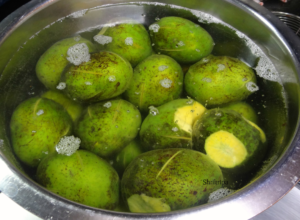
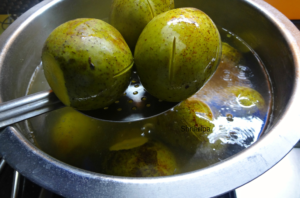
          First let’s start the pickle making by preparing the mangoes. Wash mangoes, remove its stalk part and give 3 to 4 slits here and there.

pic 3         pic 4

          Boil water in a big vessel (take half of the vessel). Add one fist full of salt to this water.

pic 5    pic 6

          Drop all those mangoes, cook until outer skin become pale green and remove from the water and drain.

          Cool this into room temperature.

          Make salt water: Take 3 cups of salt and 4 cups of water in a pan and boil this in a medium heat. How to check the doneness? Whenever salt and water quantity is right, salt will form a glossy layer at the top. If you don’t find any mirror layer, add little more salt and proceed boiling. When it is ready, switch off the gas and cool this water. It should reach room temperature, before using.

          Start making pickle masala.

          Dry roast methi, mustard and hing separately.

          Fry red chillies little by little by putting 1 tsp of oil.

          Cool everything and make powder in a mixer jar.

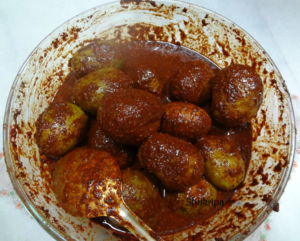
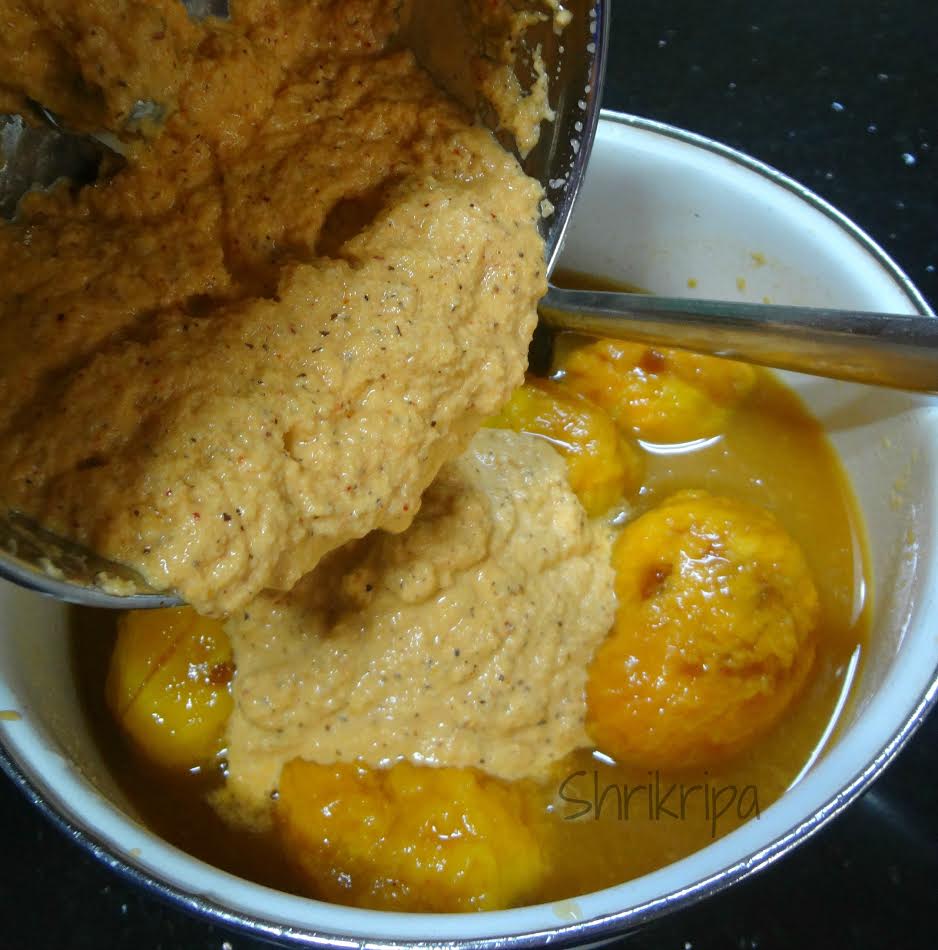
          After making powder, mix everything together nicely and take required amount of powder, pour required amount of cooled salted water and make a paste.

pic 8     pic 9

          It should be a little flowy. Because mango should immerse in this liquid.

          Add cooled mangoes and mix.

          Adjust the consistency either by adding powder or salted water.

          Store this in an air tight glass jar.

          Next 3 to 5 days every day, make it a point to mix it and keep it aside by closing the lid.

pic 1

          After one week, you can start consuming and store this in a fridge to extend its shelf life.


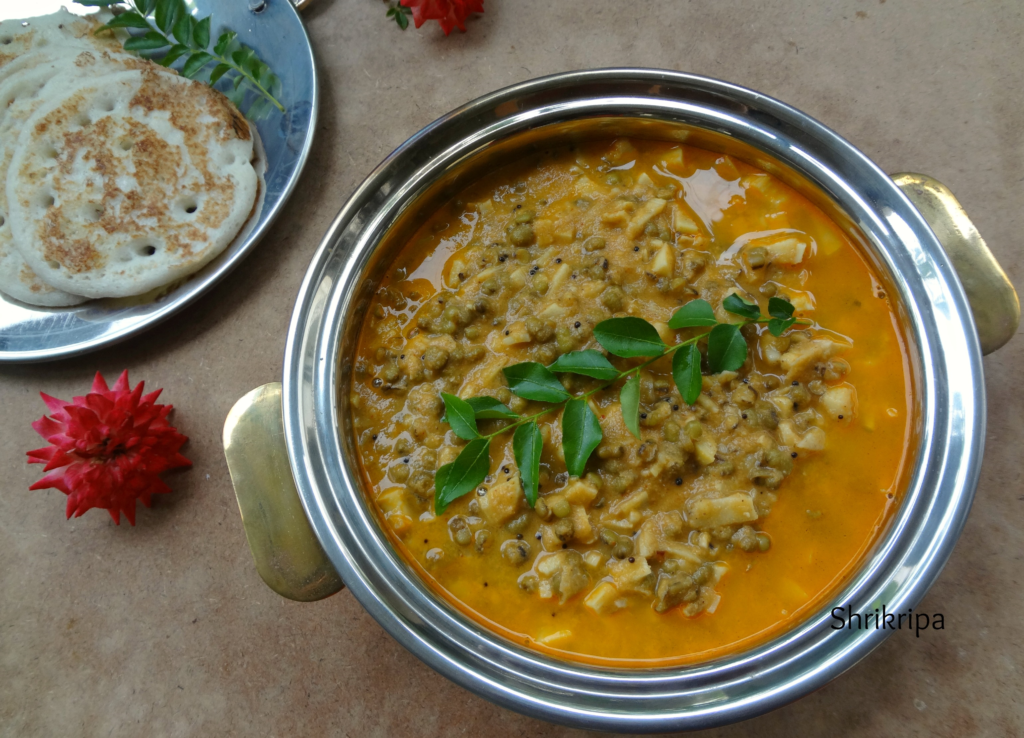
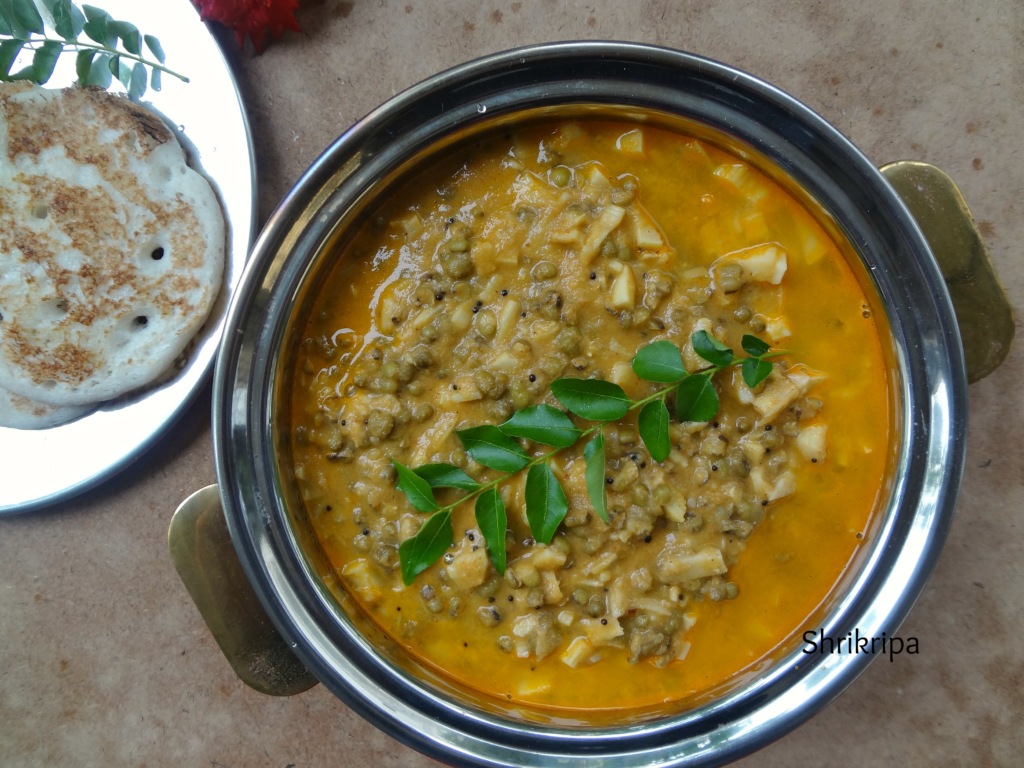
Kanile Gashi /Bamboo Shoot and sprouted moong Gravy:

Kanile is nothing but Bamboo shoot. We coastal people, prepare some delicacies from this seasonal high fibre veggie, this curry is prepared by mixing with sprouted Green gram. which is very tasty and goes very well with Dosa or Rice. So, it is a seasonal treat for us.

We normally use fresh bamboo shoot and chop it in this manner. (please refer to the Post of How to chop Bamboo shoot)

pic 19

Ingredients:

Ready Bamboo shoot – 1 cup (you can use frozen or tinned too)

Sprouted green gram /moong – 1 cup

Salt

Red chilli powder – 1teaspoon

Green chilli – 1

Turmeric – ½ tsp

For Masala:

Coriander – 2 tsp

Cumin- 1 tsp

Red chilli – 3

Garlic cloves – 2

Fresh grated Coconut – 1cup

Tamarind – ½ tsp

Seasoning:

Coconut oil – 1tsp

Mustard – 1 tsp

Curry leaves – 1 spring

Red chilli -1

Method:

  • – Cook Sprouted moong and ready to cook bamboo shoots in sufficient water, by adding turmeric, red chilli powder, and slit green chilli.

pic 16  pic 15

  • – Roast coriander, cumin, red chilli and garlic by putting little oil for masala.
  • – Grind this into smooth paste by adding coconut and tamarind and sufficient water.

pic 17  pic 18

  • – Add this ground masala to cooked mixture and boil nicely.

pic 21

  • – Do the seasoning. Heat coconut oil ,splutter mustard ,add red chilli and curry leaves fry and pour over the curry.

How to Chop Fresh Bamboo Shoot/Kanile:

Kanile or Bamboo shoots are a seasonal, hollow grass which is a young shoot of Bamboo and it is available in a very short period of rainy season. It has very distinct subtle, earthy flavour with crunchy texture while eating. It is considered as one of the health foods because of its high contents of dietary fibres,minerals and low in fat.

pic 2

Preparing Bamboo shoot for cooking is little bit of a work.

Traditionally We follow 2 methods:

 One is Chopping and soaking in fresh water for 3 days by changing the water regularly every day and using.

I personally don’t prefer this method, because it emits little odour of bamboo shoot and prepared curry will also contain that odour.

  I usually follow this second method, which I learnt from my father in law, who was super knowledgeable in all these traditional cooking procedures.

  At first take harvested Bamboo shoots which we get in hilly sides, some shops or in all Mangalore stores of Bangalore in this season.

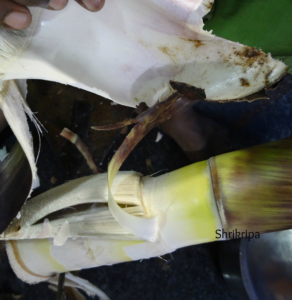
I usually buy my stock from the Mangalore store. After buying, remove outer tough layer, which is brown in colour by peeling one by one starting from the bottom.

 You can use your hand to peel the outer shell.
pic 3    pic 4

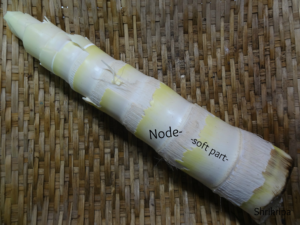
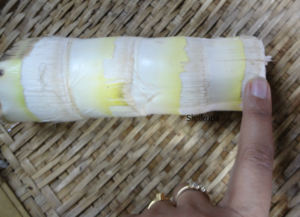
  After removing this outer woody shell, you will see only inner core which will be white in colour.

This white inner layer will have 2 parts. One is soft edible part and in between nodes.

Nodes will be thick, little sturdy and can be used in pickle making by adding lemons or mangoes.

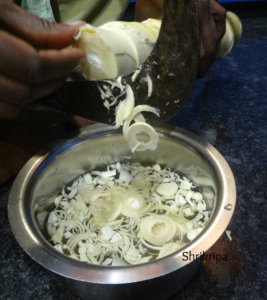
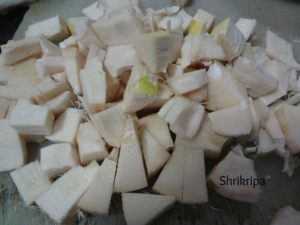
Now this is ready to chop. Take one vessel, which is filled with water and chop and immerse it in a water.

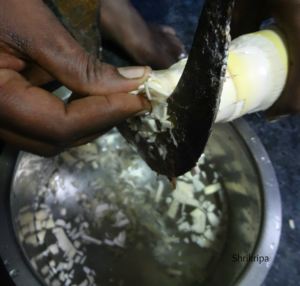
 You can either chop circular fashion or bit size pieces. It is up to one’s choice.

pic 1     pic 5

 Start to chop from top of the conical area, proceed until you find a hard node. When you feel the node (here nodes were thick from 5th onwards) discard the node by cutting that part and proceed the chopping.

pic 6   pic 8

Now Take all the chopped bamboo, sieve the immersed water and put fresh water and cook this in a cooker for one whistle.

pic 12   pic 13

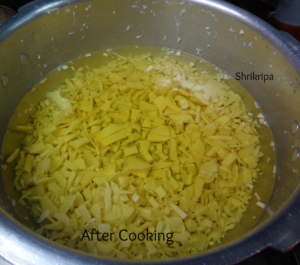
 When you open the cooker lid, you will see the water in yellow shade, discard this water by draining.

pic 14

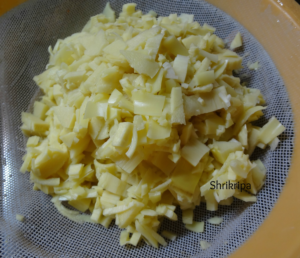
Now collect the cooked Bamboo shoot and it is ready to cook by removing its impurities and natural bitterness.Use it in whatever dish you want to make.

How to Use nodes in Pickle making –

pic 9  pic 10

-Collect nodes, chop however you want and proceed with the above procedure as bamboo shoot. Cook in a pressure cooker with water and strain the yellow water, cool completely and use in pickle making.


Jack Fruit Dosa:

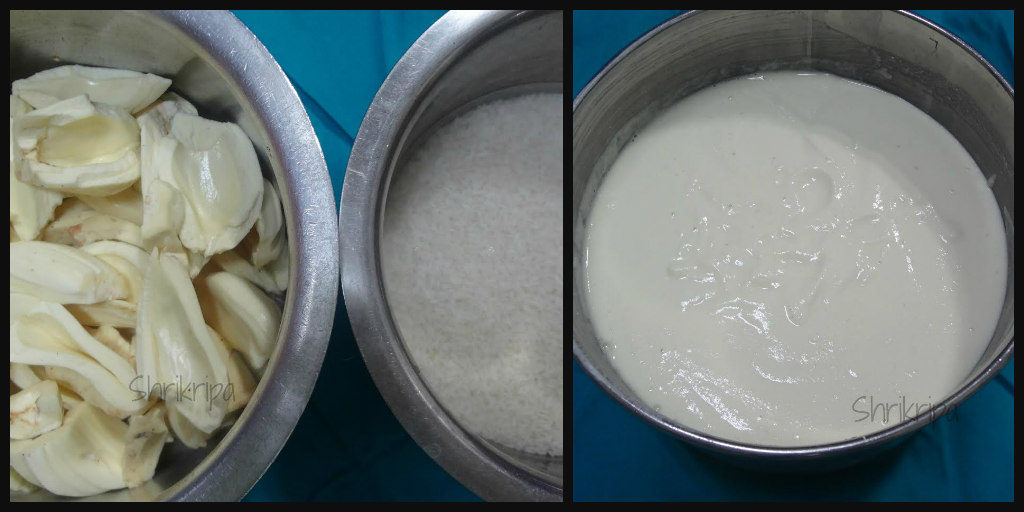
Jackfruit Dosa is known as “Halasina hannina dose”. It is a traditional recipe of Mangalore. Here we use Soaked Raw Dosa rice and ripe jackfruit to make the batter. we can call this as a Jack pancake and serve with honey or with ginger chutney.

pic 5

Ingredients:

Dosa rice – 2 cups

Cleaned jack fruit – 1 big bowl

Salt

Method:

-Wash and soak Dosa rice in sufficient water for 3 to 4 hours.

– Chop the jack fruit, remove bulbs and separate outer cover and inner seed.

pic 1

– Collect only the outer yellow shell and put it in a mixer grinder, give couple of whipping sessions and remove.

-So that while grinding it will be easy to handle.

– Now take soaked rice, ground or crushed fruit, put little water and grind this in to a smooth paste by adding sufficient salt. Batter should be a little thicker than normal Dosa.

pic 2

-If you want to use this batter for the next morning, please refrigerate the same and use for the next day.

pic 3

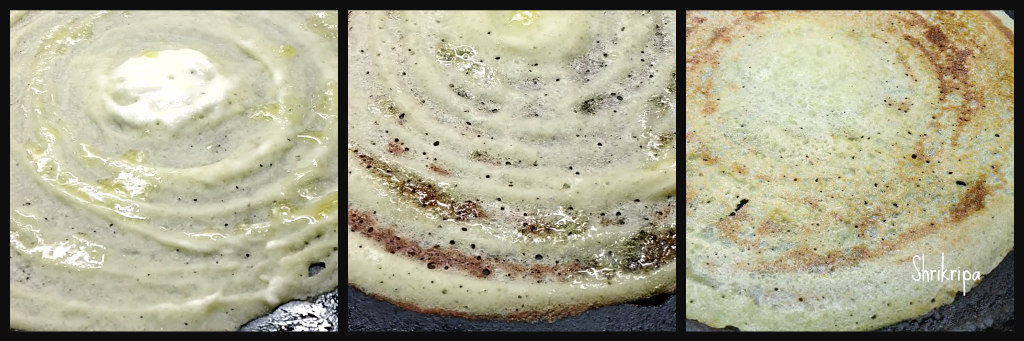
– make Dosa’s by using hot iron griddle. No need to ferment this batter. Use ghee while roasting this Dosa. It should be a little thicker than normal Dosa. (thinner than set Dosa). When it is cooked, flip it and cook on the other side.

pic 4

-serve this with honey or with ginger chutney.

Note:

For ginger chutney: Fry red chillies with little oil and grind it with coconut, salt, little tamarind and piece of ginger.


Brined Mango:

“Neeru Mavinakayi” is what we call Brined mango, which is basically a firm fully grown, matured but un-ripened mango which is preserved in salt water. We usually relish this in the rainy season or in the off season by preparing some of our traditional dishes.

pic 8            pic 7

For this we usually use wild mangoes, which are smaller in size and stays and tastes very good too for a long time.

Here in Bangalore, I don’t get wild variety and I usually pick a smaller sized mango, which is sour and locally it is used for pickle.

Now we will see how to proceed with this mango-

Ingredient:

Raw, firm, well grown Mango – 3 kgs

Crystal Salt or table salt – 1 ½ to 2 cup

Drinking water – to immerse.

Glass Bottle – Big size

Method:

  • Select well grown, firm mangoes.
  • Wash, and keep it ready.
  • Take glass bottle or porcelain bottle, fill all these mangoes, put salt and pour water until all the mangoes are immersed.
  • Close the lid and keep this aside.
  • Next day morning, check for the salt and if water is not salty in taste, add little more and adjust.
  • Water should be salty and if it is done, keep this jar in a corner for a couple of months or until its outer skin becomes little lighter in colour.
  • When it is ready, you can use this for any brined mango recipe. I ahve shared Neerumavinayi chutney as well as Gojju and you can select the hyperlink to see.


Kadu Mavina hannina Sasive / Wild Mangoes in coconut and mustard sauce:

Wild mangoes are known as Kadu mavina hannu in our local language. Which is very fibrous, tangy as well as sweet in taste. It has distinct taste, it is widely used in varieties of curries in our region. This particular curry doesn’t need any heating and is a perfect treat for summer. Usually we enjoy this with hot rice.

unnamed

Ingredients:

Wild mangoes -5-6

Salt – to taste

Jaggery – to taste

Fresh Coconut gratings – 1 bowl

Red chillies – 2

Mustard – 1 tsp

Seasoning: Coconut oil – 1 tsp, mustard – 1 tsp, Red chilli – 1, Curry leaves – little.

Method:

–  Wash wild mangoes, remove top part of the mango, remove outer skin and keep this in a separate vessel. Keep inner fruit part in another vessel.
unnamed (1)

  Add one cup of water to outer skin, mash nicely, collect pulpy water and add this to fruit. Discard outer remaining skin. Add required amount of jaggery, salt and mix.

  Grind fresh coconut, mustard and red chillies to a fine paste by adding little water.(No need to roast Chillies and mustard)

  Add this ground paste to mango and check for the seasoning. If needed add some more grated jaggery or salt.

                      unnamed (2)

  Season by using coconut oil. When it is hot, add mustard, after it splutters, add red chilli and curry leaves, add this to mango curry.

  Enjoy this with hot rice.

NOTE:

-If you don’t have access to wild mango, don’t worry. Pick up any varieties of mango, peel the outer skin and chop the fruit into bite size pieces and proceed with above method.


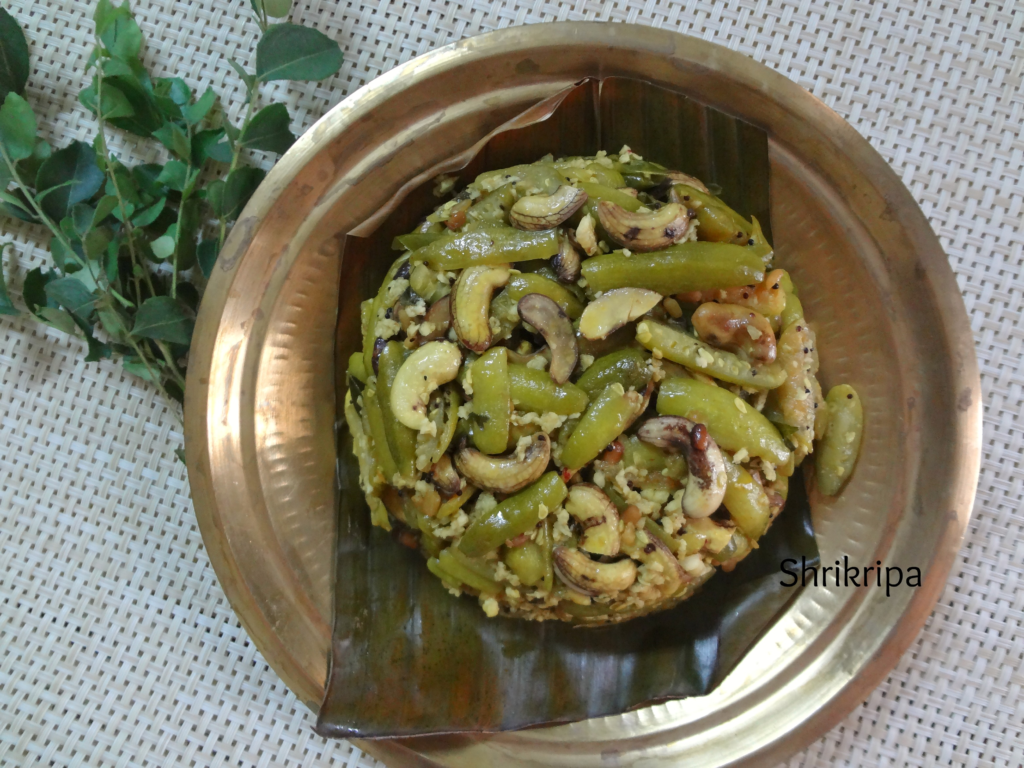
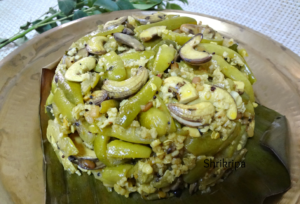
Thondekayi Ele Geru beeja Palya / Ivy gourd with Tender Cashew stir fry:

Vishu is one of the important festivals of Kerala and our coastal region. It comes in April and usually on 14th.Traditional rituals are followed to bring in prosperity and we (lady of the house) will assemble Vishu-kani at Pooja room. It comprises all the fresh crops, vegetables, rice, gold, money, flower and pot full of water and one mirror. On the festival day morning, after taking bath, family members will see this “Kani” and seek the blessings of the god and from the elders. Usually at this time of the year, fresh cashew crop starts and cashew is one of the main crops of our region. Only for this festival we pluck fresh raw green cashew and prepare either payasam or kheer with chana dal or cashew and ivy gourd dry curry. This particular side dish is a must in almost all the festivities and weddings. Which is a speciality of Mangalore region.

This side dish has no other masala’s other than green chilli and coconut flavour.

pic 2

Ingredients-

Ivy gourd – 500 gms

Tender cashew – 100 kernels

Green chillies – 3 to 4 (slit)

Coconut oil – 1 table spoon

Mustard seeds – 1 tsp

Red chillies -2

Urad dal – 1 tsp

Curry leaves – 2springs

Turmeric – ½ tsp

Salt

Jaggery – ¼ tsp.

Method:

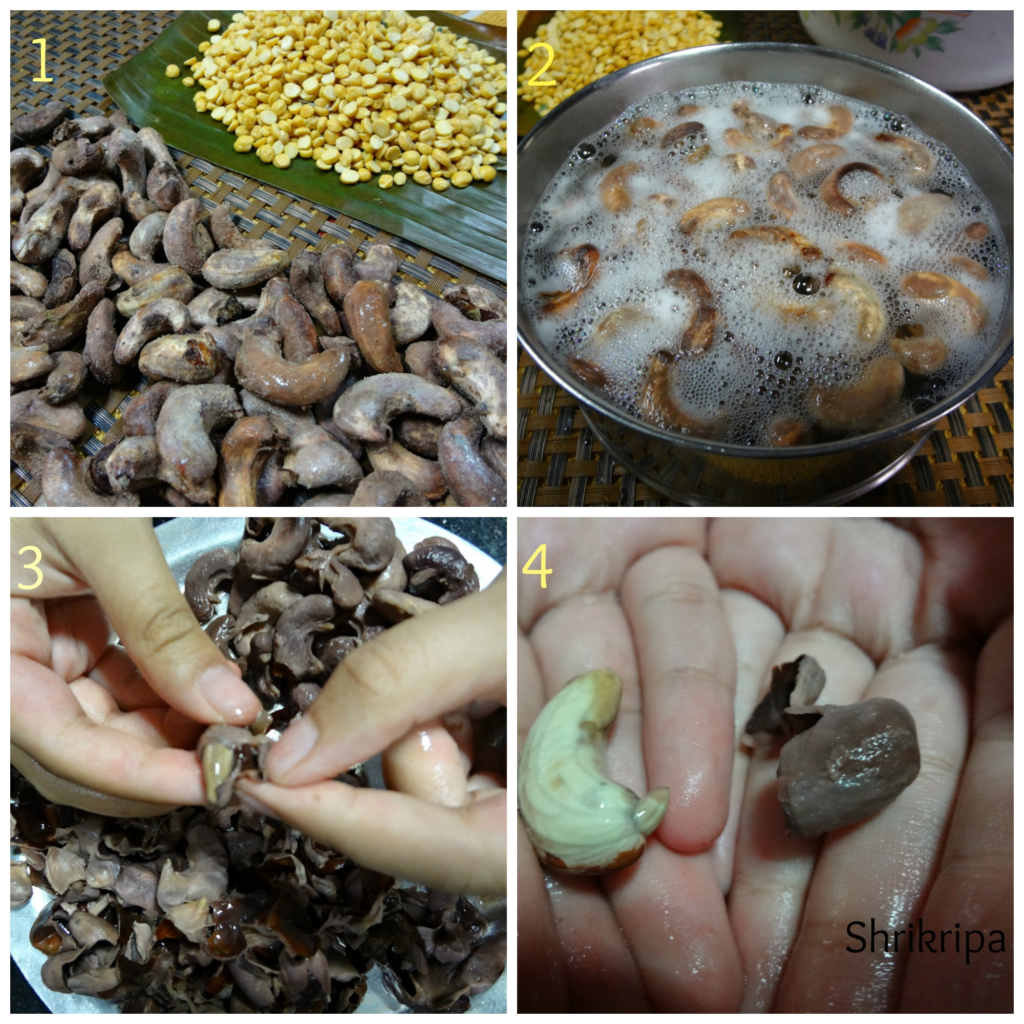
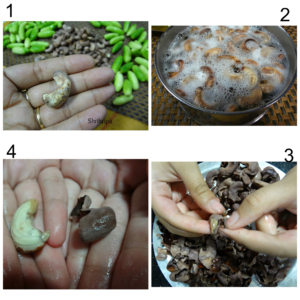
-At first we have to remove outer cover of the young cashew. Take one bowl, put all those young and raw cashew kernels into it, pour boiling water and keep it aside for 10 to 15 minutes by closing the lid.

collage

-When outer cover of the kernels swells, remove the outer cover and keep aside.

-Chop ivy gourd after washing it thoroughly. Make 4 lengthwise pieces of each gourd.

-Now take one thick bottomed kadai or clay pot, heat oil for the seasoning. Put mustard, when it splutters add urad dal, red chillies.

pic 3

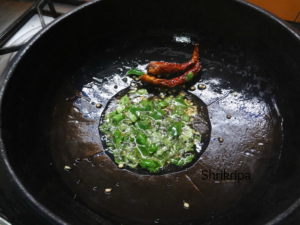
-When urad dal becomes red, add curry leaves and slit green chillies and fry a little.

pic 4

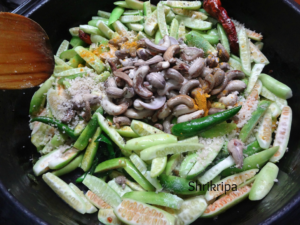
-Next, add chopped ivy gourd and cashew kernels, turmeric, salt, jaggery and fry until it wilts a little.

pic 5

-Now add one cup of water and close the lid and cook this in a low fire until it is done.

pic 6

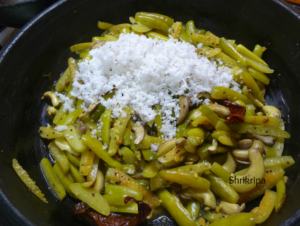
-Lastly add grated coconut and mix and cook until it is done.

pic 1

Note:

– One pack of Young cashew, that we get in the market has 100 kernels. In Bangalore, I get these from the Mangalore Store (all Mangalore stores will have it when it’s the season)

-If you are using regular cashew, cook the cashew first by putting water and salt in cooker for 2 whistles, drain the water and then proceed as above method.

RAW JACKFRUIT DOSA:

Raw jackfruit Dosa is known as “Halasina kayi dose”. It is a traditional recipe of Mangalore. Usually Jack season is always a feast in our coastal area. We have so many dishes of jack from its raw form to ripe. This particular recipe is one among them and it is freshly prepared and served with Honey or coconut- ginger chutney. No fermentation is required. This particular Dosa is very crispy as well as paper thin. Jack used in this is freshly plucked, before ripening and in a raw form.

Ingredients:

Dosa rice – 2 cups

Raw jack – 1 big bowl

Salt

Method:

-Wash and soak Dosa rice in sufficient water for 3 to 4 hours.

– Chop raw jack, which should be really fresh and should not be ripe. Remove bulbs and separate outer cover and inner seed. Chop these bulbs into tiny pieces, so that grinding will be easy in mixer grinder.

– Now take soaked rice, chopped bulbs, put little water and grind this in to a smooth paste by adding sufficient salt.

– If you want to use this batter for next day morning, please refrigerate the same and use next day.

-make paper thin Dosa’s by using hot iron griddle. No need to ferment this batter. Use ghee while roasting this Dosa.

-When it is little brown and roasted, flip this and cook on the other side.

-serve this with honey or with ginger chutney.

Note:

For ginger chutney: Fry red chillies with little oil and grind this with coconut, salt, little tamarind and piece of ginger.


Kadle Bele –Gerubeeja Payasa / Chana dal and Cashew Kheer:

Happy Yugadi! Yugadi is celebrated as the beginning of a new year in India (but through different names). In Bangalore, we start this festival by eating neem and jaggery. Neem denotes the bitterness we face in life, and the jaggery represents all the sweet things of life. By eating the neem and jaggery together, it is a symbol of promising ourselves to face the bitterness and sweetness of life with confidence.           

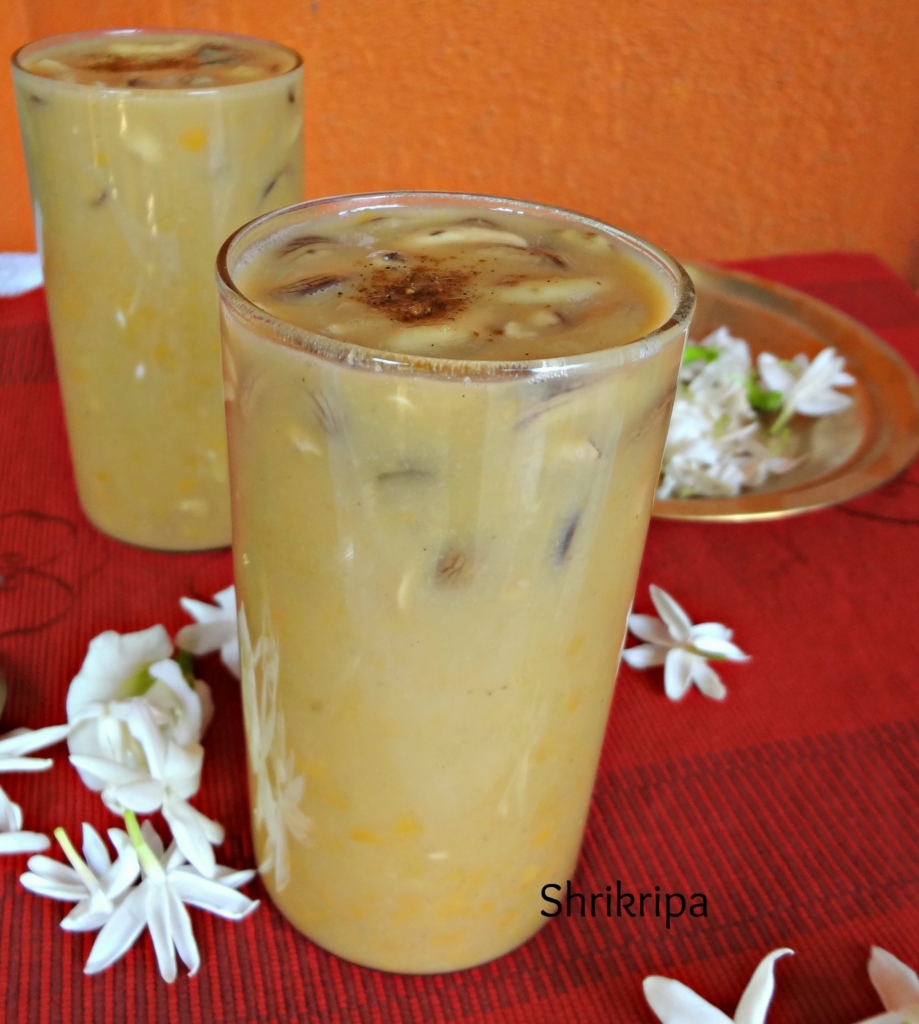
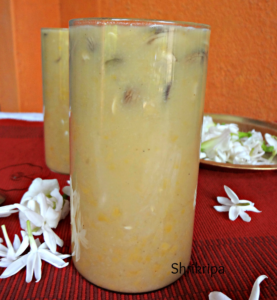
In Mangalore, we celebrate this festival by savouring a kadle Bele (Bengal gram or chanadal) and gerubeeja (raw cashew) Payasa. It is a delicious dessert which is made more delightful because of the cashew nuts which are present in every spoonful.

pic main

We will see the procedure –

Ingredients:

Chana dal/Split Bengal gram – 1 cup

Whole raw Cashew – 1 cup

Coconut milk – 1 tetra pack

Jaggery – 1 ½ block (used Organic jaggery blocks)

Cardamom powder – ½ tsp.

Salt – ½ tsp.

Method:

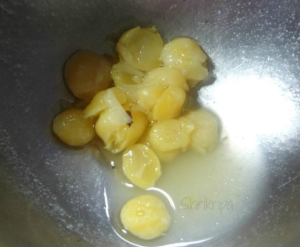
-At first we have to remove outer cover of the young cashew. Take one bowl, put all those young and raw cashew kernels into it, pour boiling water and keep it aside for 10 to 15 minutes by closing the lid.

-When outer cover of the kernels swells, remove the outer cover and keep aside.

collage 1

-Wash chana dal and cook this in a cooker by putting sufficient water for two whistles.

-Cook dal till it is perfectly cooked. Dal should be well cooked and easily crushed. Doneness is very important, after adding jaggery, dal becomes little stiff and firm.

pic 2

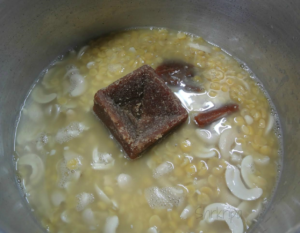
– When its pressure relieves add cashew kernels and cook. After one whistle, switch off the gas and cool this.

-Now add salt and jaggery and boil till you get a nice aroma and till the raw smell of jaggery disappears.

pic 3

 – When it is done, add one tetra pack of coconut milk and give one boil. That is it. Garnish with powdered cardamom and enjoy.              

           pic 12              pic main

        Note: –

          If you don’t have access to raw cashew kernels, you can use regular cashew and you can cook this with Chana dal for 3 whistles and proceed by adding jaggery.

           If you are using fresh coconut for extracting milk, take grated coconut (from one coconut), add one cup of water and grind, and extract milk. (This is a thick extract and should be added at the end)

          Once again add little water and grind, to take out thin milk and you can add this while boiling jaggery.

          If you are using regular jaggery, at first self-boil this with little water, make a liquid and sieve this before adding to the kheer, to remove impurities.